
Professional stage lighting mobilizes an average of 80 to 200 projectors on a standard concert and represents 25 to 35% of the overall technical budget of a show. Much more than a technical device, stage lighting sculpts the space, dramatizes the artists and orchestrates the emotions of the public in real time. VLS, audiovisual and stage technical provider for 40 years, designs custom lighting plans for shows, concerts, tours and TV sets. In 2026, this article dissects the typology of stage projectors (fresnel, cut-out, PAR, moving heads), the principles of the lighting plan, the lighting budgets by gauge, and the VLS field feedback on large platforms. You will find the lighting really used in Parisian halls, regional festivals and international tours, with the choices of equipment that make the difference between a memorable show and a memorable visual signature.
Why stage lighting structures any live show
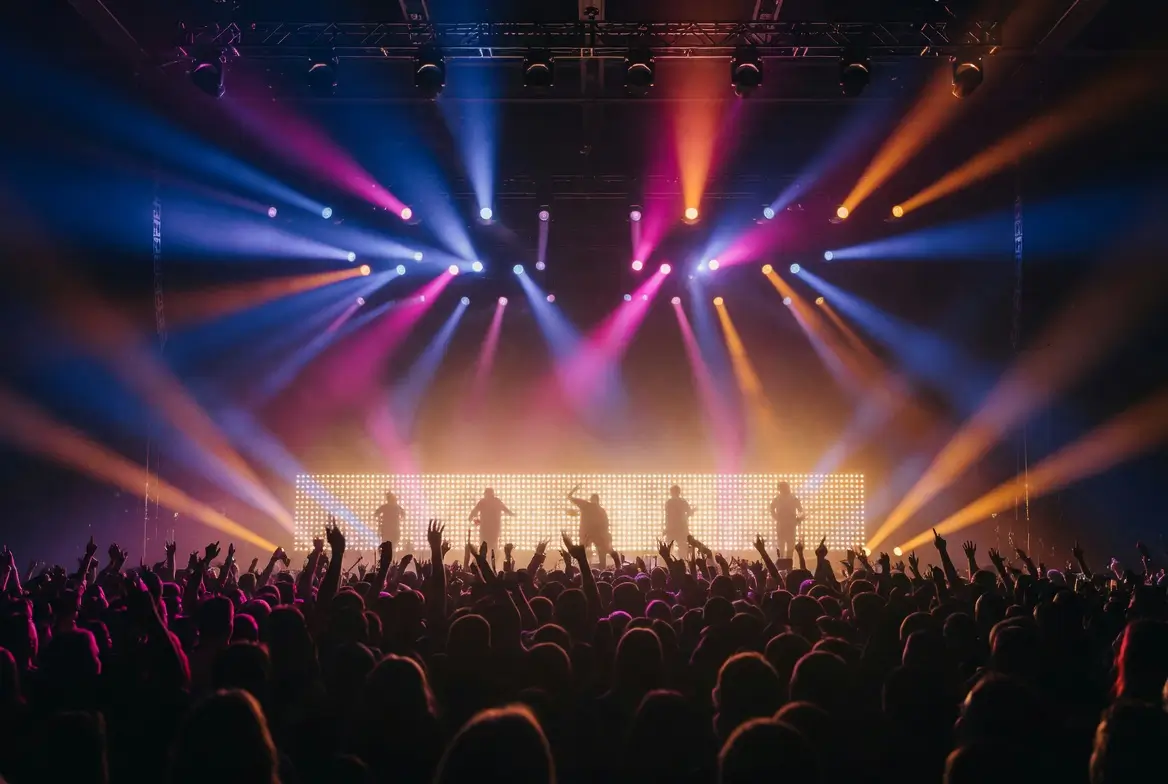
THEstage lighting is never just about lighting a scene to make it visible. On a show set, light builds the dramaturgy, prioritizes the shots, isolates the artists from the set and synchronizes the emotion with the live music. A concert without stage lighting mastered becomes a simple public rehearsal, while a properly lit show falls into the territory of artistic experience. This difference, immediately perceptible to the spectator, is based on precise technical choices made well before the first dress rehearsal. The design of a light plan often begins six to eight weeks before the concert date, and involves a permanent dialogue between the artist, the director and the lighting designer.
First of all, thestage lighting visually prioritize the scene. By isolating the lead singer using a cutting beam, by coating the backing singers with a side wash, and by counterlighting the musicians with a controlled ramp, the designer directs the eye without saying a word. Then, the stage light synchronizes the emotion with the music. A change of color on a chorus, a black cut on a transition, or a sweep of beams on an electronic drop transform the collective feeling. Finally, thestage lighting builds the visual identity of the show. Daft Punk, Beyoncé or Stromae concerts are instantly recognizable by their lighting signature, and this signature is built in the choice of projectors, colors and effects.
In the field, VLS has noticed that artists are now refusing generic lighting plans. Each tour requires tailor-made work, sometimes reconfigured city by city according to the constraints of the venues. A 6,000-seat Zenith does not accept the same rig as an 800-seat club room, or an Italian-style theater with 1,200 seats. This adaptability makes all the value of an experienced technical service provider. But above all, thestage lighting must interact with sound and video. When these three disciplines converge, the show reaches a coherence that leaves a lasting impression on the audience. That is why VLS coordinates systematically The teams are and The video teams right from the design phase.
- Visual hierarchy: Light directs the eye of the beholder without cognitive effort
- Emotional sync: colors and intensities adjusted to the musical tempo in real time
- Show identity: Recognizable light signature that serves the artist's image
- Room adaptability: Light plan reconfigured according to gauge, grill height, decks available
- Multimedia coherence: permanent dialogue with sound and video for a unified rendering
Type of stage projectors: fresnel, cut-out, PAR, lyres and servo-controlled projectors
Understand thestage lighting modern requires the mastery of the main families of projectors. Each meets a specific need and has its own optical, mechanical and electronic characteristics. An experienced lighting designer juggles these tools daily to compose a coherent and legible lighting plan. The fleet of equipment available in 2026 combines modernized historical technologies (LED fresnel, hybrid cuts) and recent innovations (hybrid beam-spot-wash heads, white laser sources). This diversity makes it possible to address all scenic contexts, from intimate theater to an outdoor festival of 50,000 people. VLS has a complete fleet covering these categories, with leading references from Robe, Ayrton, Clay Paky and ETC.
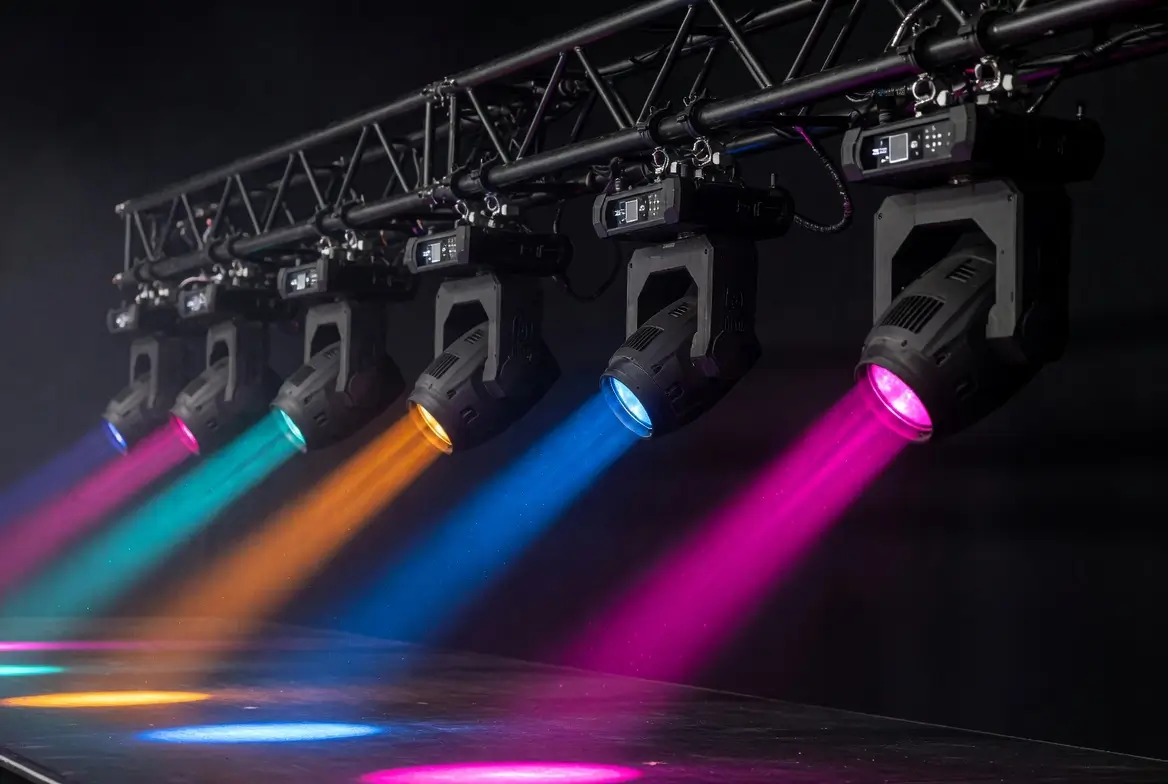
The Fresnel projector remains the basic tool for any theater and concert lighting plan. Its striated lens diffuses soft light with blurred contours, ideal for colored cloths and ambient lighting. The modern LED fresnel range (ETC Source Four LED Series 3, Robe T1 Fresnel) delivers 800 to 1,500 useful lumens with an adjustable angle of 12 to 70 degrees. Les cutouts, for their part, project a beam with clear contours that can be sculpted using internal knives. Essential for isolating a face or projecting a gobo, they equip all professional theaters. The absolute reference remains the ETC Source Four, available in tungsten, LED and hybrid versions.
The PAR (Parabolic Aluminized Reflector) is the most used concert projector in forty years. Robust, bright, economical, it produces a powerful oval beam ideal for backlights and side washs. Modern LED PARs (Robe ParFect, GLP impression X4) consume 200 to 300 watts compared to 1,000 watts for a traditional PAR 64. La Lyre enslaved, or moving head, motorized pan, tilt, color, gobo and zoom via DMX. A lyre wash (Robe MegaPointe, Ayrton Domino) creates dynamic tablecloths. A lyre spot (Clay Paky Mythos, Ayrton Bora) projects clear beams. A lyre beam (Robe BMFL Spot, Clay Paky Sharpy) tears space apart with ultra-powerful fine rays visible from over 300 meters away.
Finally, the hybrid slaves combine in 2026 the three functions wash, spot and beam in a single machine. This versatility reduces the number of projectors required and speeds up installation. On international tours, where every kilo saved counts, these hybrid machines have become essential. VLS thus equips its tours with Robe MegaPointe and Ayrton Diablo, two references that are consensus among French lighting designers.
- Fresnel: soft and homogeneous tablecloths, theater and acoustic concert, 12 to 70 degrees
- Cutout: sculptable net beam, face isolation, gobo projection
- BY: backlight and side wash, powerful oval beam, economical
- Lyre wash: dynamic colored tablecloths, fast movements, DMX programming
- Lyre spot: Precise beam with gobo, isolation, and graphic effects
- Lyre beam: ultra-powerful rays visible from afar, festival and stadium
- Hybrid: three functions in one, weight and logistics savings on tour
A well-managed fleet of equipment makes all the difference on stage. The technique remains invisible when it works, but it is immediately obvious when it fails.
Building a coherent stage lighting plan
The plan ofstage lighting is the reference document that describes the position, type, and function of each projector on the stage. This technical map guides the installation, programming and operation of the show. Without a clear lighting plan, the technical team improvises on site, wastes hours and delivers a mediocre result. A well-designed plan is built up in several superimposed layers that each respond to a specific function. This modular approach makes it possible to instantly understand the logic of the show and to modify elements without reconfiguring everything. French lighting designers generally work on Vectorworks Spotlight or WYSIWYG to model the rig in 3D before physical installation.
La sided is the first layer of the plane ofstage lighting. It lights up front artists to make them visible to the public. Composed of fresnels and cut-outs installed on the front bridge or the front decks, it generally uses a warm white at 3,200 K or a neutral white at 5,600 K depending on the aesthetic sought. Next comes the vs, or backlight, which draws the artist's silhouette from the back. On the other hand, the scene seems flat and the artist blends in with the decor. LED PARs are the preferred tools for this function, sometimes supplemented with moving heads for dynamic effects in the background.
Les Laterals or side showers sculpt the artists' bodies from the sides. They give relief to the dancers, reliefs to the musicians and accentuate the movements. Les Cycloramas, or cyclos, light up the background with very large colored sheets. This layer creates the overall ambiance and radically changes the perception of the scene with each song. Finally, the effects include all visual effect machines (beam heads, strobes, lasers, smoke or fog machines). This last layer dresses up the show dynamically and triggers the emotional highlights.
VLS managed the lighting design of the Festival Estival de Voiron 2025, an 18-meter plateau with 142 projectors on four bridge levels. The plan ofstage lighting integrated 24 beam heads in the forestage, 36 LED PAR in contrast, 18 fresnels in front and 12 cyclos for the background. This architecture allowed the three headlining artists to each benefit from a distinct lighting universe without physically modifying the rig between sets. The programming, carried out on GrandMA3, mobilized 850 cues spread over the 18 songs. For smaller festivals, VLS adapts the ratio by offering comprehensive event expertise that covers all budgets.
- Face: visibility of artists, fresnels and footbridge cuts, neutral or warm white
- Against: silhouette and depth, PAR LED at the rear grill, dimmable
- Lateral: relief on body and movements, lateral showers on tower or foot
- Cyclorama: general atmosphere, wide colored tablecloth on stage background
- Effects: Beam heads, strobes, lasers, smoke machines for highlights
Lighting artists versus room: two distinct logics
On a show set, thestage lighting must manage two very different objects: the artists and the room. These two logics coexist but are never confused. Understanding this distinction avoids classic mistakes (lighting the room instead of the scene, or vice versa) and allows the lighting plan to be properly calibrated. The lighting of artists aims to make them legible, beautiful and expressive. That of the room aims to immerse the audience in an atmosphere without depriving them of a comfortable experience. This tension between legibility and immersion structures the entire profession of light designer.
The lighting of artists follows specific rules. First, the face-to-face ratio. Good stage lighting gives 60 to 70% of the intensity to the face and 30 to 40% to the opposite. This imbalance creates relief without flattening the face. Then the color temperature. For an artist with fair skin, 3200 K flatters skin tones, but 5 600 K is better for matte skin. An RGBW neutral white wash allows you to adjust in real time according to the invited artists. Finally, the shadows. Pure headlight produces flat shadows and crushes the face. A 45-degree lateral cross sculpts the features and gives character, a technique inherited from classical photographic portraiture.
The lighting of the room follows a different logic. It can aim at total invisibility (classical theater, where the audience stays in the dark) or on the contrary at maximum immersion (electronic concert with lasers and strobes sweeping the pit). Between these two extremes, numerous configurations exist. During a pop concert, we often integrate a few beam lyres oriented towards the audience into the choruses, creating an effect of collective unity. On a stand-up show or a company meeting, constant dim lighting is maintained in the pit to allow note taking and interactions.
VLS accompanied the 2025 tour of a French pop artist in 14 Zéniths, i.e. 84,000 cumulative spectators. The challenge was to reproduce the visual experience identically despite rooms of varying dimensions (Zenith de Paris-La Villette at 6,800 seats versus Zenith de Limoges at 5,500 seats). The plan ofstage lighting was pre-programmed in pre-production on GrandMA3, then adapted city by city in less than two hours using a parametric show file. This industrialization of the process, now standard on major tours, frees up time for artistic work and guarantees visual coherence.
- Face-to-face ratio: 60-70% face and 30-40% against for balanced relief
- Artist temperature: 3200K fair skin, 5600K matte skin, multi-purpose RGBW
- Lateral cross: 45 degrees to sculpt face and avoid flat shadows
- Invisible room: classical theater, audience in total darkness
- Immersive room: Lasers, beams and strobes for electronic concerts
- Subdued room: meeting and stand-up, reading and possible interactions
Consoles, organ games and DMX programming in 2026
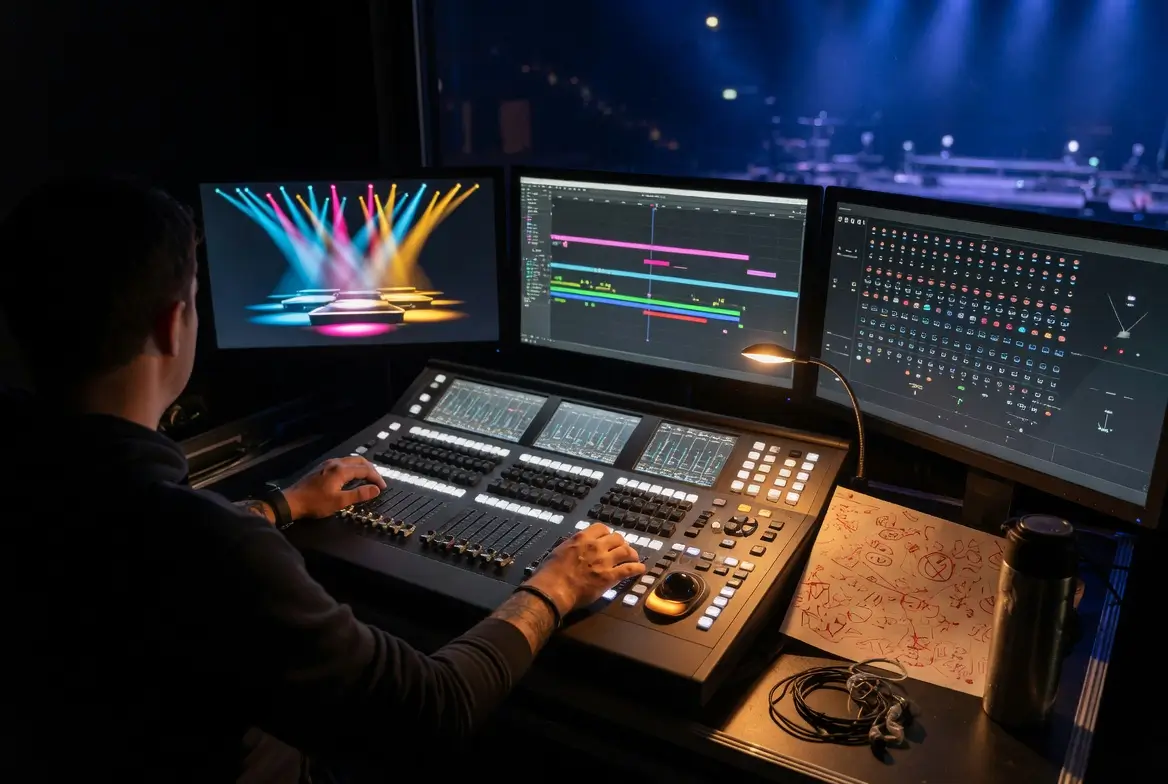
None stage lighting Modern does not work without a control console. This central tool, sometimes called organ play, programs light states and triggers changes in real time during the show. The console sends orders to projectors via the DMX 512 protocol, a universal standard since 1986, now often encapsulated in an Ethernet network (Art-Net or sACN) to reduce cabling. In 2026, the professional market is concentrated around a few major brands that dominate international tours and permanent theaters. Choosing the right console determines the fluidity of programming and the speed of operation during the show.
La GrandMA3 by MA Lighting remains the absolute reference for large format concerts, festivals and international tours. Its programming power, its reliability and its global user network make it the de facto standard. Light operators trained on GrandMA find work all over the world. The console easily manages several thousand parameters simultaneously and synchronizes light, video and SFX via timecode. La GrandMA2, which is still very widespread, is still used on around 60% of major tours due to its considerable installed base.
La Chamsys MagicQ seduced by its quality-price ratio and its openness. Available in a free software version with an affordable dongle, it equips many regional theaters and independent companies. Its learning curve remains accessible to novice operators, and its advanced features rival high-end consoles. La Avolites Diamond maintains a loyal user base in the world of concerts and musicals, especially thanks to its efficient touch interface. La ETC Eos, omnipresent in permanent theaters and operas, excels in programming cue-heavy shows.
The Dimmer, or dimmer, remains essential for non-LED sources (halogen, tungsten). Although gradually replaced by the internal drivers of LED projectors, it still equips all old theaters. Modern dimmer blocks (ETC Sensor, Robert Juliat) accept up to 96 circuits per cabinet and can be controlled in DMX like any other controller. For 2026 installations, VLS systematically recommends migrating to all-LED when the budget allows it, which eliminates the need for dimmers and drastically simplifies the technical chain. This transition, which is already well under way in the sector, results in a 40% reduction in the electricity consumption of shows.
- GrandMA3: standard international tours, powerful programming, global ecosystem
- Chamsys MagicQ: unbeatable value for money, regional theaters and companies
- Diamond Avolites: touch interface, concerts and musicals
- ETC Eos: permanent theaters and operas, fine management of the views
- DMX 512: universal protocol since 1986, encapsulated in Art-Net or sACN
- Dimmer: essential for halogen sources, omitted in all-LED
Lighting budget according to the size of the show
The budget ofstage lighting varies considerably depending on the size, the duration of the show, the complexity of the show and the level of artistic requirements. Understanding the current market ranges in 2026 makes it possible to properly calibrate a project and avoid under-equipment or unnecessary additional costs. VLS establishes its quotations using a transparent method that details rented equipment, transport, assembly, operation and dismantling. This breakdown helps producers and organizers to arbitrate their technical choices lucidly. As a general rule, thestage lighting represents 25 to 35% of the total technical budget of a show, behind the sound (35 to 40%) and in front of the video (15 to 25%).
For a small gauge (300 to 800 seats, club hall or municipal theater, duration 1 hour and a half), the lighting budget varies between 4,000 and 12,000 euros per date. This envelope covers twenty projectors (8 PAR LED, 6 wash heads, 4 cut-outs, 2 effects), a basic console and a light operator. This configuration is sufficient for an acoustic concert, a contemporary dance show or a theatrical creation. Installation and transport costs remain contained because the rig fits in a single 20 m³ truck.
For a Average gauge (800 to 3,000 seats, national theater or concert hall), the budget climbs between 15,000 and 45,000 euros per date. The plan ofstage lighting then mobilizes 50 to 90 projectors with a wash, spot, beam and hybrid mix. A GrandMA2 or GrandMA3 controls the whole thing, sometimes redundantly to secure the show. The technical team on site includes two to three light technicians, a manager and a lighting designer. This configuration equips tours by established groups, national plays and musicals in the regions.
For a Large gauge (3,000 to 8,000 seats, Zenith or Main Hall), the budget increases between 60,000 and 150,000 euros per date. The rig includes 120 to 200 projectors on three or four bridge levels, two redundant GrandMA3 consoles, lasers, fog, and sometimes integrated video mapping. The lighting team consists of 5-6 technicians, plus a lead lighting designer and a programmer. For the stadiums (10,000 seats and more, Stade de France, Accor Arena, Accor Arena, Lille Pierre-Mauroy), the budget regularly exceeds 250,000 euros per date with rigs of 300 to 500 projectors and complex scenographic structures integrating video, motorization and pyrotechnics.
In 2025, VLS piloted the lighting of a series of four concerts at the 17,000 seat Accor Arena, with a rig of 380 projectors on six levels of motorized bridges. The budget stage lighting alone exceeded 280,000 euros for the four dates, excluding the rental of structures and excluding the permanent team. This operation mobilized 12 light technicians, two GrandMA3 operators and a full-time dedicated programmer for three weeks of pre-production. The figures speak for themselves: on this level of requirement, thestage lighting is no longer an expense, it is a strategic artistic investment. For a tailor-made project, contact The VLS team who will draw up a quote adapted to your context.
- Small gauge (300-800): 4,000 to 12,000€, 20 projectors, basic console
- Average gauge (800-3 000): 15,000 to 45,000€, 50-90 projectors, GrandMA2/3
- Large gauge (3,000-8,000): €60,000 to €150,000, 120-200 projectors, redundancy
- Stadium (10,000+): 250,000€ and more, 300-500 projectors, complex scenography
- Technical ratio: lighting = 25 to 35% of the total technical budget for the show
Stage Lighting Trends in 2026
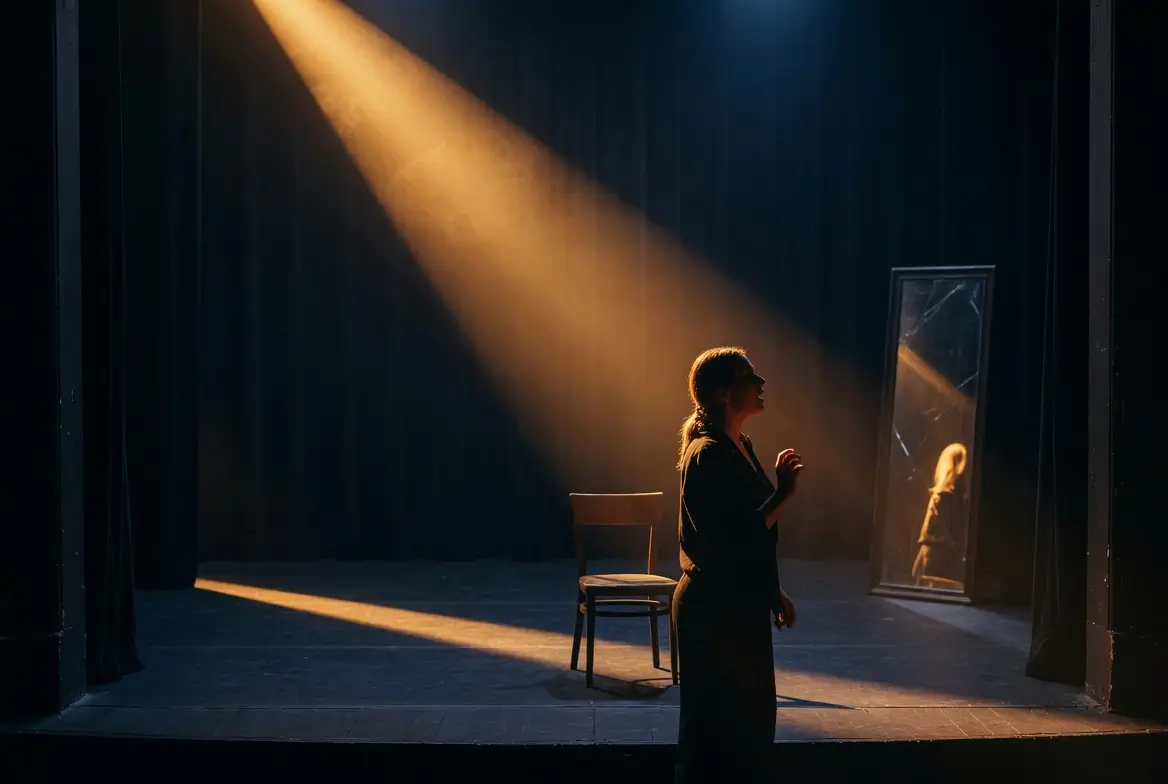
THEstage lighting is evolving rapidly in 2026 under the effect of several converging forces. The energy transition imposes less consuming projectors, the inflation of technical budgets is pushing for pooling, and artistic expectations are constantly renewing the visual codes of performing arts. Understanding these trends helps light producers and designers to invest intelligently and anticipate future needs. Several major developments are redrawing the landscape ofstage lighting contemporary and directly influence the choice of material on tours and theaters.
La Generalization of LED continued and reached approximately 85% of the French professional population in 2026. The latest resistances concern permanent theaters equipped with ancient tungsten cut-outs, but even these establishments are gradually migrating. LED reduces consumption by 70 to 90% compared to equivalent tungsten and suppresses excessive heat production on actors. White laser sources, which are still marginal, are gaining ground for applications requiring a very long range (outdoor festivals, stadiums). This technology produces a beam of unparalleled chromatic purity but remains expensive to buy.
THEvideo-light integration is progressing rapidly. Designers no longer think ofstage lighting and video separately, but as a single visual continuum synchronized via timecode. High-density LED screens (2.9 mm pitch or less) become both video support and light source for the scene. This hybridization requires light and video designers to work together from the pre-production phase. Software tools (Disguise, Notch) facilitate this integration by allowing the final rendering to be previewed in a real-time 3D environment.
La environmental sustainability is becoming a structural purchasing criterion. Producers are now asking their service providers about the carbon footprint of their park, and some festivals (We Love Green, Climax) impose strict ecological specifications. In 2026, VLS is optimizing its routes through the pool of regional equipment, which reduces the kilometers traveled by 30% on average. Finally, theartificial intelligence enter the lighting program. GrandMA3 and Chamsys plugins analyze the music in real time and suggest cues adapted to the tempo and energy of each song. This technology does not replace the lighting designer, but it significantly speeds up the initial programming phase.
- Generalized LED: 85% of the fleet in 2026, saving 70-90% of energy
- White lasers: maximum range, chromatic purity for outdoor festivals
- Video-light integration: LED screens as source, unified timecode
- Preview tools: Disguise, Notch for real-time 3D rendering
- Durability: carbon footprint, regional pool, eco specifications
- AI programming: real-time music analysis, cue suggestions
VLS field case: two concrete feedback
Beyond the theory, thestage lighting is judged on the ground. Here, VLS shares two concrete feedback that illustrate the technical and artistic trade-offs encountered in production. These cases, anonymized but representative of the projects handled by the team, show how a lighting plan is built from the initial order to the final delivery. Each project has unique constraints (budget, gauge, artistic requirements, calendar) that impose specific technical choices. The ability to quickly arbitrate between these constraints defines the expertise of a confirmed stage provider.
Case 1:18-date pop-rock tour in France and Belgium. The artist, selling 3,000 to 5,000 seats per date, required a plan ofstage lighting reproducible identically in rooms with very variable configurations (Zenith Paris, Théâtre Antique d'Orange, Cirque Royal Bruxelles). VLS designed a modular rig of 96 projectors (24 MegaPointe Robe lyres, 32 PAR LED Robe ParFect, 18 ETC Source Four fresnels, 12 asymmetric cycles, 10 effects), pre-programmed on GrandMA3 with a parametric show file. The average assembly time increased from 8 hours to 5.30 am between the first and fifth dates, thanks to the industrialization of the process and the training of the Roadie team. Total tour budget: 380,000 euros over 18 dates, or around 21,000 euros per date.
Case 2: theatrical creation at the Avignon Festival. For an independent company with a limited budget (12,000 euros for 22 performances), VLS designed a plan ofstage lighting minimalistic but expressive. The rig only had 36 projectors (12 ETC Source Four LED cut-outs, 8 fresnels, 8 PAR LED, 4 wash heads and 4 strobe effects). The programming, carried out on Chamsys MagicQ, mobilized 240 cues precisely based on the text. The challenge was to create a strong visual signature despite the budgetary constraints. The result allowed the company to obtain a national tour of 60 dates over two seasons. On this project, the creativity of the lighting designer took precedence over the quantity of material, demonstrating that a stage lighting Successful does not only depend on the budget.
These two cases illustrate a fundamental truth of the profession: there is no absolute good or bad stage lighting, but lighting plans adapted or not adapted to the artistic project. VLS sound structure Lighting equipment park to meet the full range of needs, from independent clubs to international stadiums. This versatility is based on forty years of cumulative experience and a constant investment in new technologies. Also discover our complete catalog of stage equipment to explore all available resources. To understand the international technical standards that govern show lighting, consult the PLASA standards, a leading professional organization in the sector.
Frequently asked questions about stage lighting
What electrical power should be provided for concert stage lighting?
The electrical power required depends on the type of projectors used. For a rig of 80 modern LED projectors (PAR mix, lyres, fresnels), count around 35 to 45 kW of peak power, i.e. a sufficient 63 amp three-phase input. For an equivalent tungsten rig, the consumption increases to 120 or 150 kW, requiring a 125 amp or a dedicated generator. In 2026, the transition to LED reduces the power required by an average of three, which simplifies installation and reduces connection costs. VLS systematically sizes the electrical needs in advance of the estimate to avoid any unpleasant surprises on site, and collaborates with energy partners for isolated sites.
How many projectors are needed for a concert in a hall with 1,500 seats?
A hall with 1,500 seats (medium gauge) generally requires 60 to 80 projectors for complete professional stage lighting. A typical configuration includes 16 controlled moving heads (8 wash, 8 spot or hybrids), 24 LED PAR backlighting, 12 fresnels or cut-outs in front, 8 cycles for the background and 4 to 6 effects (strobes, smoke machines). This base is complemented by a GrandMA2 or Chamsys MagicQ console controlled by a trained operator. The material and operating budget is around 18,000 to 25,000 euros per date depending on the duration of the show and the complexity of the programming requested by the artist.
Should you prefer LED or tungsten for classical theater?
In 2026, LED emerged even in classical theatre, despite the historical attachment to tungsten. Modern LED cut-outs (ETC Source Four LED Series 3) faithfully reproduce the heat of tungsten (CRI 95 and above) with 70% energy savings. Tungsten maintains a marginal advantage in spectral continuity perfect for high-fidelity photography, but this advantage becomes insignificant in theatrical use. The maintenance of an all-LED park is also much easier: no lamps to change (lifespan 50,000 hours versus 750 hours), no dimmers required. The savings accumulated over five years more than justify the initial investment, which is generally amortized in two to three seasons.
How do you synchronize stage lighting, sound and video in concert?
Synchronization is done through SMPTE or MIDI Time Code timecode. A master console (often an audio sequencer like Ableton Live or Pro Tools) generates the timecode and sends it to the light (GrandMA3) and video consoles (Disguise, Resolume). Each console triggers its cues programmed to the millisecond on the received timecode, guaranteeing perfect and repeatable synchronization. This method is now used on almost all major tours and allows identical shows to be repeated night after night. VLS masters this integration on concerts, musicals and live TV broadcasts, with a team dedicated to timecode synchronization.
What is a gobo and how do I use it on stage?
A gobo is a metal or glass disc pierced with patterns, inserted into a cut-out or a spot light to project a precise shape onto the scene. Metallic gobos produce simple patterns (stars, waves, geometric shapes), while glass gobos allow for complex and colorful images. Lighting designers use gobos to create textures (foliage, water, brick effects), project logos during product launches or visually structure the scene. A modern head spot integrates 8 to 16 rotating gobos interchangeable via DMX. VLS has a library of more than 200 standard gobos and manufactures custom gobos by subcontracting for projects requiring a unique signature visual.
What certifications are mandatory to operate stage lighting in France?
Several certifications govern the use of stage lighting. The NF C 15-100 standard regulates the entire electrical installation (differential circuit breakers, grounding, cable sections). Technicians must have a minimum B1V electrical authorization (low voltage, simple live work), ideally BR for team leaders. For load-bearing structures (bridges, towers), a CACES R486 nacelle category certificate is required for operators at height. The employer must also have appropriate professional liability insurance. ERP (Establishments Receiving the Public) impose additional rules concerning evacuation markings and scenic smoke. VLS certifies its entire technical team and brings each installation into compliance before opening to the public.
VLS fully supports your projectstage lighting, from initial advice to tour operation. Our dedicated event team brings together lighting designers, technicians, programmers and managers trained on global references (GrandMA, Chamsys, Robe, Ayrton). Forty years of experience serving the biggest French and international stages, from Zenith to regional festivals, from national theaters to musicals on world tour.
You are preparing a show, a concert or a tour and you are looking for a reliable technical partner forstage lighting ? Contact VLS for a personalized quote and a technical exchange with our lighting designers. We support producers, artists and cultural institutions throughout France and Europe.
Conclusion: stage lighting, a technical art at the service of emotion
Mastering thestage lighting in 2026 requires combining technical culture (projectors typology, DMX protocols, console programming), artistic sensitivity (reading the booklet, dialogue with the director) and operational rigor (security, planning, logistics). This article has swept away the fundamentals of the profession, but each show remains a unique project that requires tailor-made thinking. Successful stage lighting becomes invisible: it serves the show without competing with it, it accompanies the emotion without dictating it, it structures the space without imposing itself. It is this art of technical transparency that distinguishes the good service provider from the great service provider.
The 2026 trends (generalized LED, video-light integration, environmental sustainability, AI applied to programming) are gradually transforming practices without questioning the fundamentals. Investing in a stage lighting quality remains one of the most profitable levers for magnifying a show, because light directly affects the emotions of the audience without going through the filter of rational analysis. VLS remains your trusted technical partner for these projects, with forty years of cumulative experience, a high-end equipment park and teams trained to the best international standards.
Ready to design your next stage lighting plan? Our team supports you from design to operation. Contact VLS now for a free technical audit and a quote adapted to your project, whether it is a concert, a tour, a theatrical creation or a festival.
