
Event scenography is the art of orchestrating space, lighting, visuals, and sound to transform an event into a memorable experience. In 2026, the French event market is valued at over 32 billion euros according to Unimev, and 78% of participants consider the quality of the scenography to be crucial in their memory of a corporate event.

Specifically, a successful event scenography increases message retention by 65% compared to an event without well-executed staging. VLS, a premium audiovisual technical provider since 1985, designs custom setups annually for LVMH, the Ritz Paris, Samsung, and monumental mappings on cathedrals. This comprehensive guide deciphers the technical and creative components of event scenography, the design stages, realistic budgets, and 2026 trends, illustrated with concrete premium field cases.
What exactly is event scenography?
Event scenography refers to the art of designing and staging a temporary space to serve a specific purpose: to celebrate, communicate, sell, or inspire. It borrows its compositional rigor from theater but applies it to various corporate, cultural, or commercial contexts. Specifically, it articulates five major technical components that must interact harmoniously: lighting, video, sound, stage structure, and set design. Each staging setup tells a story, guides the eye, and evokes a measurable emotion in the spectator.
Beyond simple decoration, event scenography is a strategic discipline that responds to a precise creative brief. This is why it requires the collaboration of a multidisciplinary team: a scenographer for artistic direction, a general stage manager for coordination, and lighting, sound, video, and stage technicians. But above all, it relies on experienced technical providers capable of transforming a vision into operational reality. VLS has been active in this field for forty years for brands like BMS, Sopra Banking, or Yves Saint Laurent at the Trianon, ensuring visual coherence and technical reliability on every project.
In other words, event design goes beyond simply setting up a stage and a few spotlights. It orchestrates an immersive narrative where every element (light, sound, image, structure) reinforces the overall message. A corporate kick-off doesn't require the same scenographic approach as a gala, a product launch, or monumental mapping. It's this subtle adaptation to the context that distinguishes a event design premium event design from ordinary event decor.
The Technical Components of Successful Event Design
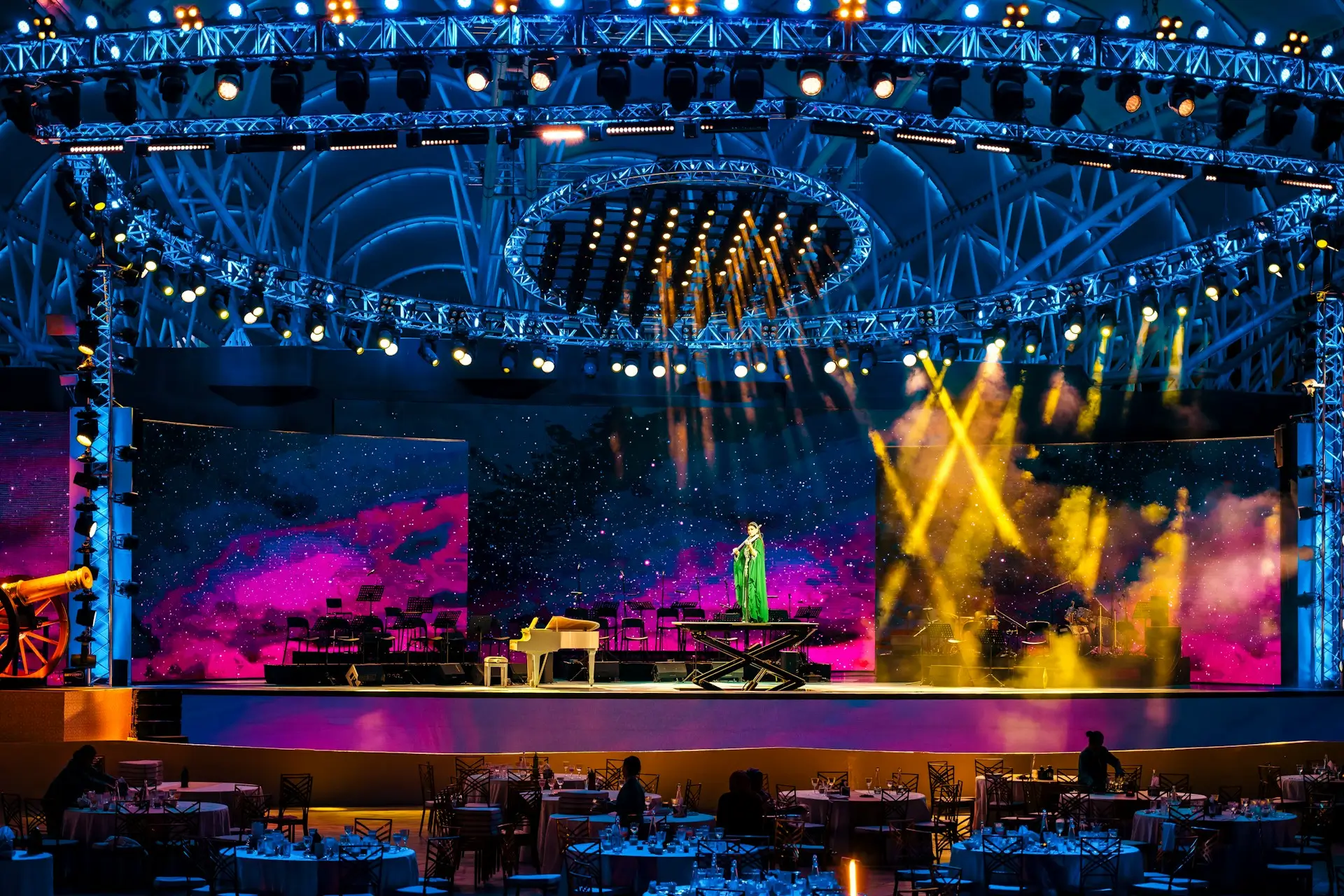
To understand event design, we need to break down its five fundamental technical pillars. Each has its own vocabulary, standards, and specialized providers. But it's their integrated orchestration that creates the final experience. Indeed, exceptional lighting with mediocre sound ruins the immersion, and vice versa. Therefore, the main challenge is to balance each component according to the client's brief priorities and venue constraints.
First, lighting sculpts the space and prioritizes areas of interest. It accounts for approximately 30 to 40% of the technical budget for a high-end event design . Leading event brands (Robe, Ayrton, Martin) equip premium stages with DMX-controlled moving heads via MA Lighting grandMA3 consoles. Color temperature, intensity, gobos, and dynamic effects must follow the event's narrative rhythm. Specifically, a gala calls for a warm white at 3000K with golden accents, while a corporate kick-off will require a more rigorous neutral white at 5600K.
Next, video has become central to any contemporary event design . High-definition LED walls (1.9mm to 3.9mm pitch), ultra-high brightness 4K video projectors (15,000 to 30,000 lumens), Disguise or Resolume Arena media servers for interactive content. Architectural projection and video mapping can transform a heritage building or a simple facade into a dynamic canvas. VLS has notably carried out several mappings on cathedrals in partnership with local authorities, demonstrating the mastery of millimeter-precise geometric calibration required for this type of operation.
Furthermore, sound must serve the stage design without compromising it. L-Acoustics K-Series or d&b audiotechnik line array systems dominate demanding stages. Homogeneous coverage, speech intelligibility, and musical dynamics are the three key criteria. Furthermore, the discreet integration of speakers (invisible suspensions, meticulous cabling) contributes to the overall visual quality. Poorly calibrated sound ruins the experience, even with exceptional lighting and video.
Finally, the stage structure and set design complete the setup. Modular platforms, triangulated aluminum structures (Prolyte, Eurotruss), textile drapes, custom stage furniture. This invisible infrastructure supports everything else and ensures the safety of technicians and the public. It should be noted that ERP (Public Access Buildings) standards impose strict certifications on each structural element, so choosing a compliant provider like VLS is non-negotiable for a professional event.
The design stages of premium event scenography
Designing a event scenography demanding follows a structured six-step process. This methodology, refined by VLS over hundreds of productions for LVMH, Air France, or Samsung, ensures adherence to the creative brief, deadlines, and budget. Indeed, skipping a step systematically leads to technical or budgetary overruns downstream. Therefore, each phase must be formally validated before moving to the next.
First, the creative brief and needs analysis phase lays the foundation. The scenographer and production manager meet with the client to understand the objective (brand image, communication, celebration, launch), target audience, brand codes, and practical constraints. This active listening stage typically lasts 2 to 4 hours and results in a precise specification document. Without this foundation, the entire event scenography that follows risks missing its target and disappointing the client.
Next, the technical site visit phase is crucial. The production manager visits the venue (theater, private mansion, atypical location) to measure ceiling heights, permissible loads on rigging points, available power supplies, equipment access, and acoustic constraints. Specifically, a neglected site visit for a Ritz Place Vendôme event can turn a well-managed operation into a logistical nightmare. That's why VLS systematically dispatches two experienced technicians for every premium site visit.
Then comes the stage design phase and the production of 3D plans. Software like Vectorworks Spotlight, Capture Argo, or Wysiwyg allows for precise modeling of the stage setup before actual assembly. The client thus validates the overall aesthetic, camera angles, and furniture placement. This step saves valuable on-site hours and avoids unpleasant surprises on the day of the event. Furthermore, it facilitates communication with the decor, catering, and fire safety teams.
Consequently, the content programming phase naturally follows. Media servers (Disguise, Resolume Arena, Watchout) receive video content, lighting cues are programmed on the MA console, and sound playlists are validated with the DJ or orchestra. SMPTE timecode synchronization ensures that every visual and sound effect occurs at the precise moment. This technical precision distinguishes a event scenography professional from a mere amateurish event setup.
Setup and general rehearsals constitute the penultimate critical phase. Depending on the project's scope, setup lasts 1 to 5 days, followed by a full technical rehearsal with extras or presenters. Every transition is tested, every sequence validated. This is when last-minute adjustments are made, because the reality of the venue always holds unexpected surprises. Finally, the event performance itself is overseen by a production manager and their control room team, ready to manage any technical unforeseen event in real-time.
Event Scenography Trends in 2026
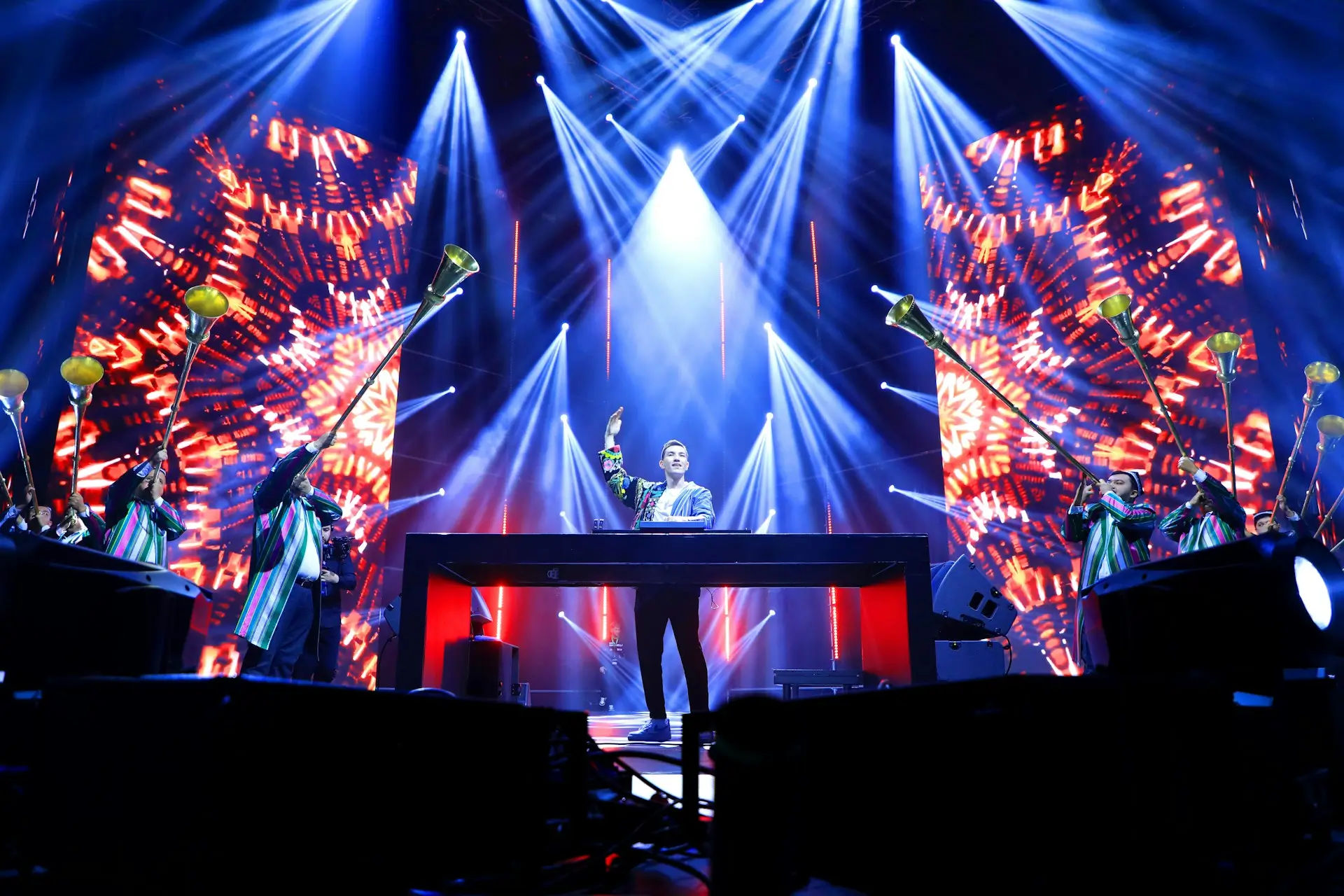
Event scenography is rapidly evolving due to several structuring trends in 2026. Understanding these transformations allows us to anticipate the expectations of demanding clients and invest in the right technologies. Indeed, premium brands now want stage setups that combine visual impact, environmental sustainability, and technological innovation. Therefore, providers who stick to outdated solutions quickly lose commercial competitiveness.
First, immersive video mapping is establishing itself as a premium scenographic signature. On architectural surfaces (heritage facades, cathedrals, private mansions), it transforms the building into a narrative canvas. VLS has created several monumental mappings that gathered up to 8,000 spectators in a single evening. Specifically, this technique requires 30,000-lumen video projectors from brands like Panasonic or Christie, millimeter-precise geometric calibration via Disguise media servers, and custom creative content produced by specialized studios.
Next, widespread LED integration is revolutionizing stage setups. High-definition LED walls (1.5mm to 2.6mm pitch) are gradually replacing indoor video projectors, offering superior brightness and impeccable contrast even in brightly lit rooms. Additionally, floor LED and ceiling LED extensions create 360-degree immersive environments. This trend is redefining event design for high-end product launches and fashion shows, such as those at the Trianon for Yves Saint Laurent.
Furthermore, immersive sound (3D audio, d&b Soundscape, L-ISA L-Acoustics) is rapidly gaining traction. Instead of traditional stereo, sound is spatialized and can follow a performer on stage or create precise movement effects. This technique, developed for concerts and theater, is now being adopted for premium corporate events. That's why VLS regularly trains its sound engineers on L-ISA tools to meet the most demanding briefs from clients like LVMH or major Parisian fashion houses.
Moreover, ecological sustainability is becoming a major selection criterion in 2026. Corporate clients now demand a detailed carbon footprint for stage setups, more energy-efficient LED moving heads, reusable sets, and optimized transport. According to the Unimev 2026 barometer, 64% of event organizers now include eco-design as a criterion for evaluating providers. Therefore, latest-generation LED equipment and reusable modular solutions are naturally prevailing over traditional energy-intensive and single-use setups.
Finally, event hybridization (in-person + live broadcast) imposes new constraints on event design. The setup must work equally well for the in-person audience and for remote viewers via streaming platforms. This requires anticipated camera framing, lighting adapted for 4K capture (consistent temperature, flicker-free), and sound mixed for two distinct audiences. VLS has perfected these hybrid setups, notably for Sopra Banking conventions broadcast simultaneously in Paris, London, and Madrid.
Case studies: premium event design by VLS
To concretely illustrate high-end event design , several VLS case studies are insightful. These achievements demonstrate that a successful production combines technical mastery, creative sensibility, and flawless logistical coordination. Indeed, each premium project presents unique constraints that demand a tailored approach. Therefore, mechanically replicating a formula from one event to another invariably leads to disappointment.
First, the case of the LVMH Mercier cellar in Épernay illustrates the delicate nature of event design in a heritage site. The classified cellars demand absolute respect for the stone, stable temperatures, and discreet integration of technical equipment. VLS deployed high-CRI RGBW architectural LED lighting to enhance the vaults, an 8x4 meter transparent LED wall for brand content, and an immersive L-ISA sound system that transforms the tasting into a complete sensory experience. The main challenge was suspending technical loads without any anchoring into the historic stone.
Next, the Ritz Paris Place Vendôme represents the archetype of ultra-premium event production. For a luxury product launch in the heart of the Salon Vendôme, VLS designed a minimalist yet technically sophisticated event design : dimmed 2700K indirect lighting, an ultra-thin LED screen integrated behind a semi-transparent textile drape, and discreet ceiling-mounted sound. The Ritz's brief required the technical setup to remain completely invisible to VIP guests, so every cable and every fixture was meticulously placed. The result: 200 prestigious guests experienced the event as magical, without ever seeing a trace of stage equipment.
Additionally, monumental projection mapping on cathedrals is another VLS signature. On structures like Amiens Cathedral or Saint-Étienne de Bourges, the technical challenge is colossal: irregular surfaces up to 50 meters high, geometric calibration on sculpted stone elements, and strict heritage constraints from the Ministry of Culture. VLS typically coordinates 6 x 30,000-lumen video projectors, a Disguise gx2c media server, and a wide-field sound system for 5,000 to 10,000 outdoor spectators. Specifically, calibration takes 3 full nights of work to achieve the visual perfection expected by the commissioning local authorities.
Moreover, the Yves Saint Laurent event at the Trianon in Paris demonstrated VLS's expertise in high-end fashion shows. The stage setup combined a 25-meter catwalk bordered by 1.9mm pitch peripheral LED walls, 24 Robe MegaPointe moving heads controlled via timecode synchronized with the original soundtrack, and a d&b audiotechnik V-Series system for 600 guests. The event design needed to complement the collection without visually competing with it. Therefore, the VLS creative team worked in close collaboration with YSL's artistic direction to calibrate every lighting effect with pinpoint precision.
Finally, the Sopra Banking international convention at La Défense Arena showcased the event design large-scale hybrid event design. 3,500 employees attended in person, with 8,000 connected via streaming from 14 countries. VLS deployed a 32x8 meter LED wall, 80 active grid moving heads, an IMAG (image magnification) system with 6 4K cameras for live broadcast, and a K-Series sound system across 5 zones. The complexity lay in maintaining visual consistency between the two audiences: what looks good in a physical venue doesn't necessarily translate well to streaming. Therefore, every shot and color temperature was calibrated for both contexts simultaneously.

Budget and Planning for Event Design
The budget for an event design varies considerably depending on the creative ambition, the scale of the stage setup, and the duration of the event. According to the Bedouk 2026 barometer, the average event design budget for a premium corporate event in France reaches 78,000 euros, but figures range from 15,000 euros for a 200-person seminar to over 1 million euros for a major international convention. Understanding these ranges helps align client expectations with technical realities and prioritize investments where they create the most impact.
For a corporate kick-off or seminar (200 to 500 people, 1 day), the budget ranges from 15,000 to 45,000 euros. This covers a standard stage setup: a 6x3 meter LED wall, a lighting rig with 8 to 12 projectors, a compact line array sound system, modular stage structure, and centralized control. VLS systematically recommends allocating a 10% contingency for technical unforeseen circumstances, because a live corporate event leaves no room for material approximations. Furthermore, an experienced general stage manager is non-negotiable for this level of service.
For a premium gala or product launch (300 to 800 guests, full evening), the budget climbs to between 60,000 and 180,000 euros. The setup then includes a event design custom event design: multiple moving heads, video mapping or peripheral LED screens, an immersive sound system, custom scenic furniture, and enhanced stage coordination. Specifically, it is within this range that VLS operates for clients such as LVMH, Ritz-Carlton, or Parisian fashion houses, with a technical team of 8 to 15 people mobilized for 3 to 5 days of production.
For monumental mapping or an international convention (1,000 to 10,000 people), the budget frequently exceeds 250,000 euros and can reach several million. This range involves exceptional technical resources: 6 to 12 30,000-lumen video projectors, giant LED walls over 30 meters wide, large-field outdoor sound systems, technical teams of 25 to 40 people, and several days of setup and rehearsal. This is why only a few providers in France, like VLS, possess the human, technical, and organizational capacity to deliver this level of event design with the expected reliability.
Beyond the initial budget, temporal planning is equally critical. For a premium event in 2026, VLS recommends starting the creative brief at least 4 months before the date, ideally 6 months for complex monumental mapping. Incompressible deadlines include technical scouting (2 weeks after brief), video content production (4 to 8 weeks), custom decor fabrication (3 to 6 weeks), and setup and rehearsals (3 to 7 days on site). Indeed, compressing these timelines multiplies costs and dramatically reduces the final quality of the delivered stage setup.
Frequently Asked Questions about Event Design
What is the difference between event design and event decoration?
The Event design is a strategic discipline that orchestrates lighting, video, sound, structure, and decor to create a complete immersive narrative serving a specific objective. It involves a scenographer, a technical director, and a multidisciplinary technical team. Specifically, it tells a story and evokes a measurable emotion. In contrast, event decoration is limited to static visual aspects: furniture, flowers, signage, table settings. It doesn't manage technical setups or dynamic storytelling. So, while decoration can enhance a venue, only well-designed event design transforms an event into a memorable experience. This is why premium brands like LVMH or Ritz-Carlton prioritize investment in event design rather than simple decoration.
How much does event design cost for a 300-person kick-off?
For a corporate kick-off with 300 attendees in 2026, the budget for event design typically ranges between 18,000 and 35,000 euros, depending on the creative ambition. This usually covers a 6x3 meter LED wall, a lighting rig with 10 to 14 projectors (wash + moving heads), a line array sound system for 300 people, a modular stage structure, and a centralized control room. The cost also includes technical scouting, setup, operation by an experienced technical director, and dismantling. Note that this budget does not include the production of custom video content, which typically adds 5,000 to 15,000 euros depending on duration and creative complexity. VLS regularly delivers this type of service for its Parisian corporate clients, and has done so for forty years.
Which service providers are involved in premium event design?
A premium event design involves several trades coordinated by a technical director. First, the scenographer provides artistic direction and designs the overall stage setup. Then, the audiovisual technical provider, such as VLS, supplies the equipment and the lighting, video, sound, and stage technicians. Additionally, the event decorator produces specific furniture and dressings, while the video content creator (motion designer, 3D studio) produces the media displayed on screens. Furthermore, qualified freelance entertainment professionals handle setup, operation, and dismantling. Specifically, for a Ritz or LVMH project, the team easily reaches 15 to 25 people, coordinated by VLS under unified production management.
How long does it take to prepare complex event design?
Preparing a complex event design requires between 4 and 8 months, depending on the project's scope. For monumental mapping on a cathedral or a major international event, allow an absolute minimum of 6 months. The typical timeline includes the creative brief and design (1 month), video content production (2 months), custom decor fabrication (1 to 2 months), technical scouting and 3D plan validation (concurrently), and finally, on-site setup and rehearsals (3 to 7 days). Indeed, attempting to compress these timelines multiplies costs by 1.5 to 2 and systematically degrades the final quality. This is why VLS politely declines overly late briefs for premium projects, to preserve its usual delivery quality.
Is video mapping always necessary in event design?
No, video mapping is not always suitable for every event design. Specifically, it makes perfect sense when the event takes place on or against a strong architectural surface (heritage facade, sculpted wall, monumental element) that deserves to be revealed by projection. However, for a classic stage with a frontal screen, a high-definition LED wall is generally more relevant and more economical. This is why VLS begins each project with thorough scouting to assess whether the venue is suitable for mapping or if classic video setups are preferred. Note that monumental mapping costs between 80,000 and 400,000 euros depending on the surface area, so the creative return on investment must justify the significant technical investment.
How to choose a reliable event staging provider?
To select a reliable event staging provider , several objective criteria are crucial. First, examine recent client references: a premium provider regularly works with demanding brands (LVMH, Ritz, Samsung, BMS) that validate its operational reliability. Next, check the company's longevity and stability: VLS has been operating since 1985, which guarantees consolidated expertise. Additionally, verify ERP compliance and professional certifications (qualified personnel, adequate professional liability insurance). Furthermore, request to visit their equipment park to check the quality and modernity of their gear (recent moving heads, high-definition LED walls, up-to-date consoles). Finally, speak with an experienced general manager to assess their thorough understanding of your creative brief. Consult VLS event expertise to assess suitability for your project.
Are you planning a corporate event, a product launch, or an ambitious staging operation? VLS supports you from concept to dismantling with forty years of expertise serving premium brands.
[SEG 8]
Contact the VLS team today
