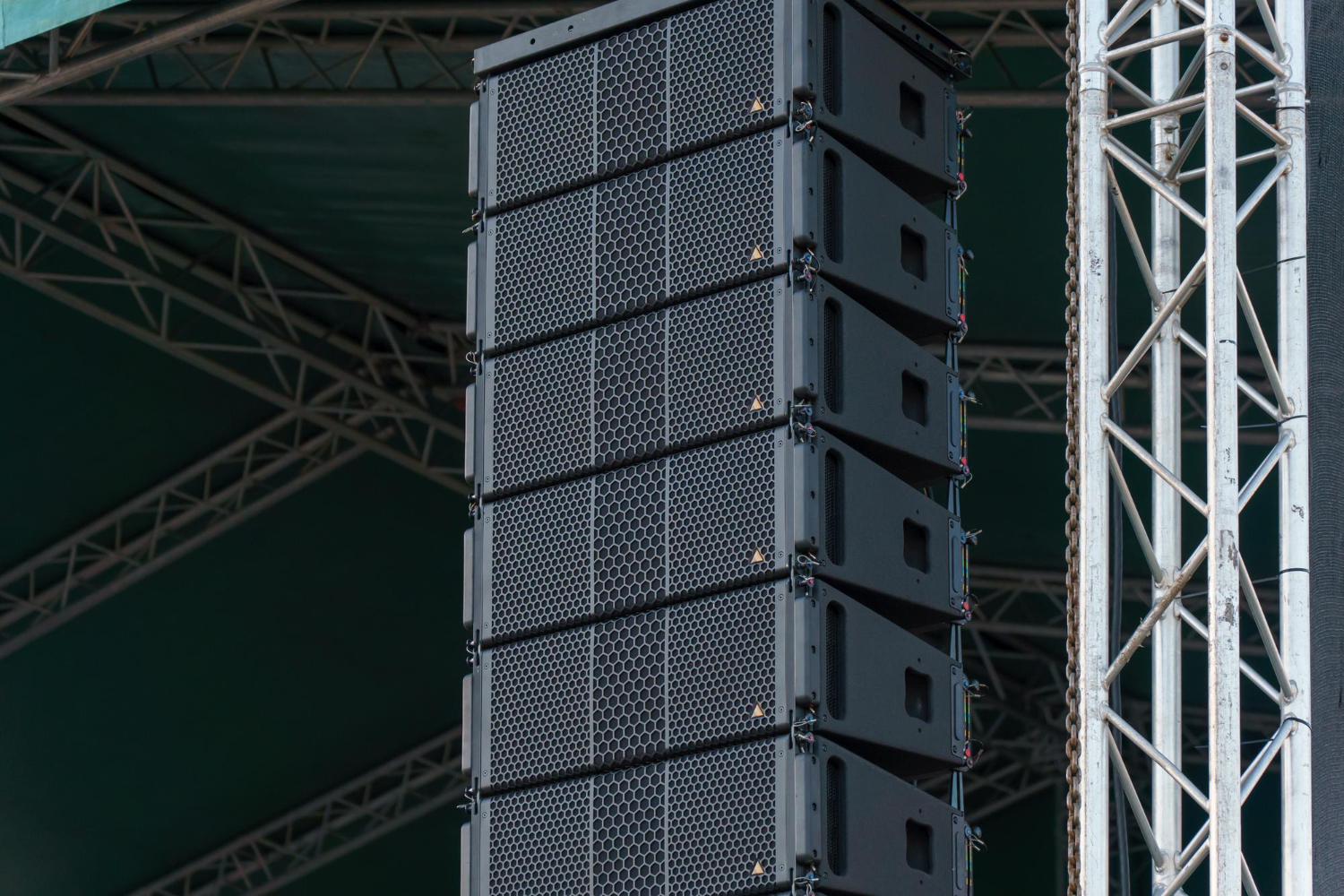

A speech that’s inaudible at the back of the room. Feedback right in the middle of a product launch. A concert that distorts at the front and fades out at the back.
These issues almost always have the same root cause: a poorly sized system. A good event sound reinforcement sound system isn't just about "adding enough speakers." It must be calculated, simulated, and adapted to each specific venue.
At VLS, we support conventions, trade shows, and festivals. Here is the method we use to size a sound system, from capacity to control.
Why sound system sizing is key to a successful event
Sound is the primary factor in how an audience perceives comfort. People can forgive average visuals. Poor sound will cause the audience to tune out within minutes.
For acorporate event, the stakes are clear:
- the executive's message must be understood by everyone,
- videos and speakers must sound consistent,
- the company's image is also reflected in the perceived quality.
An undersized system forces you to push the volume, which degrades clarity. An oversized system costs more and can create acoustic issues. The goal is the perfect balance: the right power, in the right place.
Step 1: Start with the content, not just the capacity
Two events with 500 people don't have the same sound requirements. Before we talk about equipment, we clarify what will be broadcast.
Speech: prioritizing intelligibility
For a conference or plenary session, the priority isn't power. It's vocal clarity. You need uniform coverage, a comfortable volume level (usually around 85 to 95 dB), and strict control over reflections.
Live music: prioritizing impact
For a concert or festival, you need dynamics, controlled bass, and sufficient sound pressure. Power comes into play, but within legal limits.
Mixed content
Corporate conventions often combine speeches, videos, background music, and entertainment. The system must remain neutral at low volumes while being punchy enough for festive moments. This is the most common and demanding scenario.
Step 2: reading the room like a technician
Capacity gives a general idea, but the venue dictates the result. We analyze several parameters during site surveys.
Volume and geometry
A high, wide, or long room is not sound-reinforced the same way as a square room with a drop ceiling. The shape determines the choice of speakers and their placement.
Acoustics and reverberation
A highly reverberant space (lobby, industrial hall, glass-walled room) muddies speech. When the reverberation time is long, you must:
- target the sound toward the audience rather than the walls,
- use more, smaller, and better-positioned sound sources,
- limit low frequencies that "bleed" or smear.
Conversely, a highly absorbent room sometimes requires more volume to maintain presence.
Obstacles and layout
Pillars, balconies, mezzanines, control booths at the back of the room, and giant screens: every element creates dead zones. A good sound design plan anticipates these.
Venue constraints
Some sites impose weight limits for rigging, noise restrictions, or tight setup schedules. We integrate these from the design phase.
Step 3: choosing the system architecture
Depending on the size and shape of the space, several solutions are available.
For small to medium-sized audiences (up to approximately 300 people)
A front-of-house system, with two high-quality speakers and subwoofers if the music requires it, is often sufficient. The key is to position them at a good height so that the sound is not absorbed by the front rows.
For audiences of 300 to 1,500 people
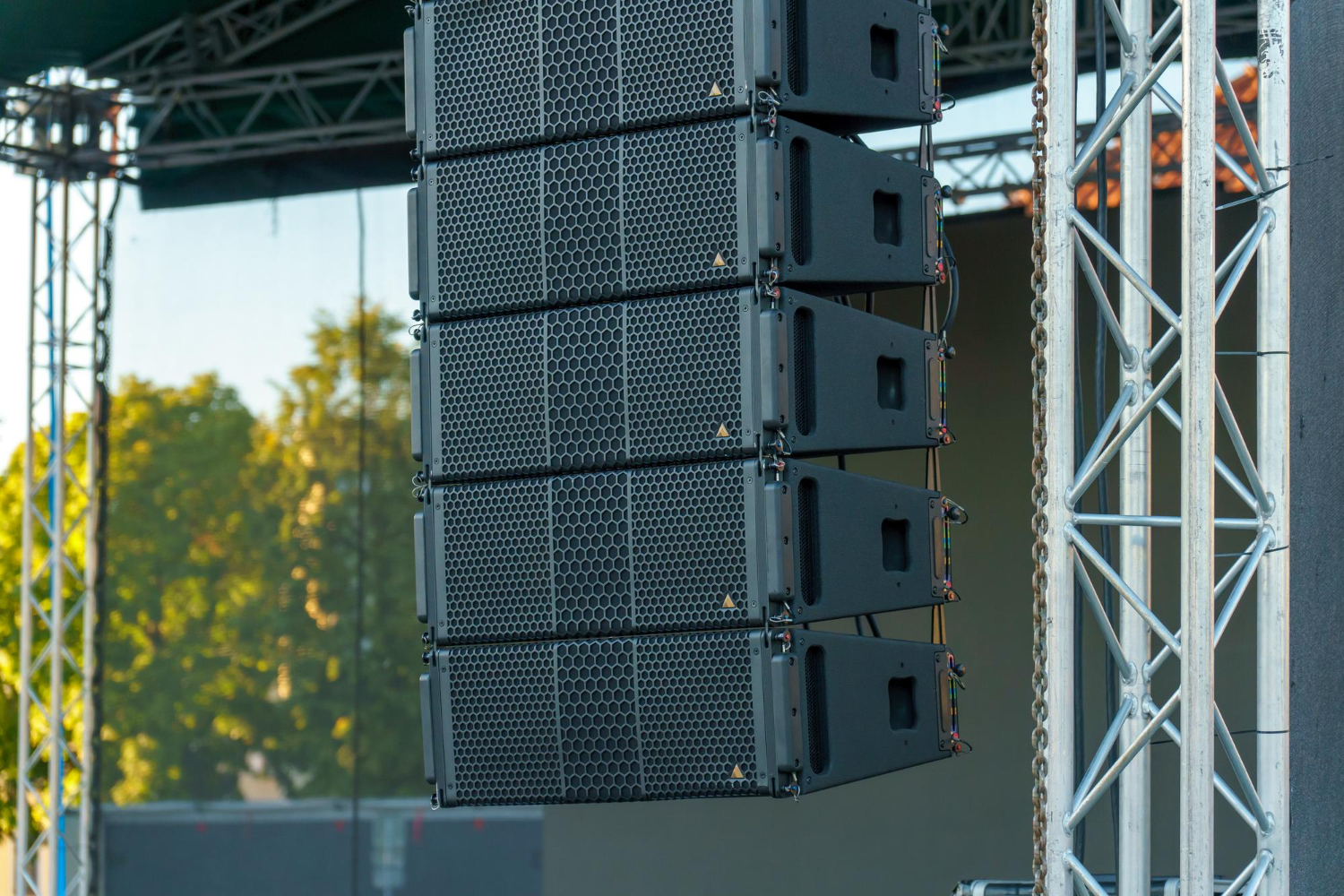
We generally move to a reinforced front-of-house system, with controlled-directivity speakers, sometimes in a line array (line array compact). We often add delay speakers for the back rows.
For large events (over 1,500 people)
We deploy flown line arrays, side clusters (side fills), and multiple delay zones. Acoustic simulation becomes essential.
The role of delay speakers
Sound loses approximately 6 dB every time the distance is doubled. Without delays, the back of the room hears sound that is quieter and delayed. Delay speakers, time-aligned with the main system, restore a consistent level. Without this adjustment, the echo effect is immediate.
Step 4: Calculate power and coverage
Proper sizing aims for three objectives.
- Sufficient level for the intended content, with some headroom.
- Consistency : no more than a 3 to 6 dB difference between the first and last row.
- Headroom : you should never run a system at its limit.
We use acoustic simulation software to model the room, position the speakers, and visualize coverage before installation. This avoids unpleasant surprises on the day of the event and allows us to justify every technical choice to our clients.
The regulatory framework
In France, sound levels are regulated for venues playing amplified music. The limit is 102 dB(A) averaged over 15 minutes, with a ceiling of 118 dB(C) peak. A good system must respect these thresholds while remaining impactful. We provide real-time measurement tools for monitoring during the event.
Step 5: Don't forget monitors, microphones, and the control booth
Sizing the main system isn't enough. The entire signal chain matters.
Stage monitors
Speakers and musicians need to hear themselves. Well-placed monitors prevent them from having to raise their voices or play too loudly.
Microphones and frequencies
For events with many wireless microphones, frequency management is critical. Nearby rooms, trade shows, and wireless networks can cause interference. We perform a frequency scan and coordination before every event.
Sound mixing
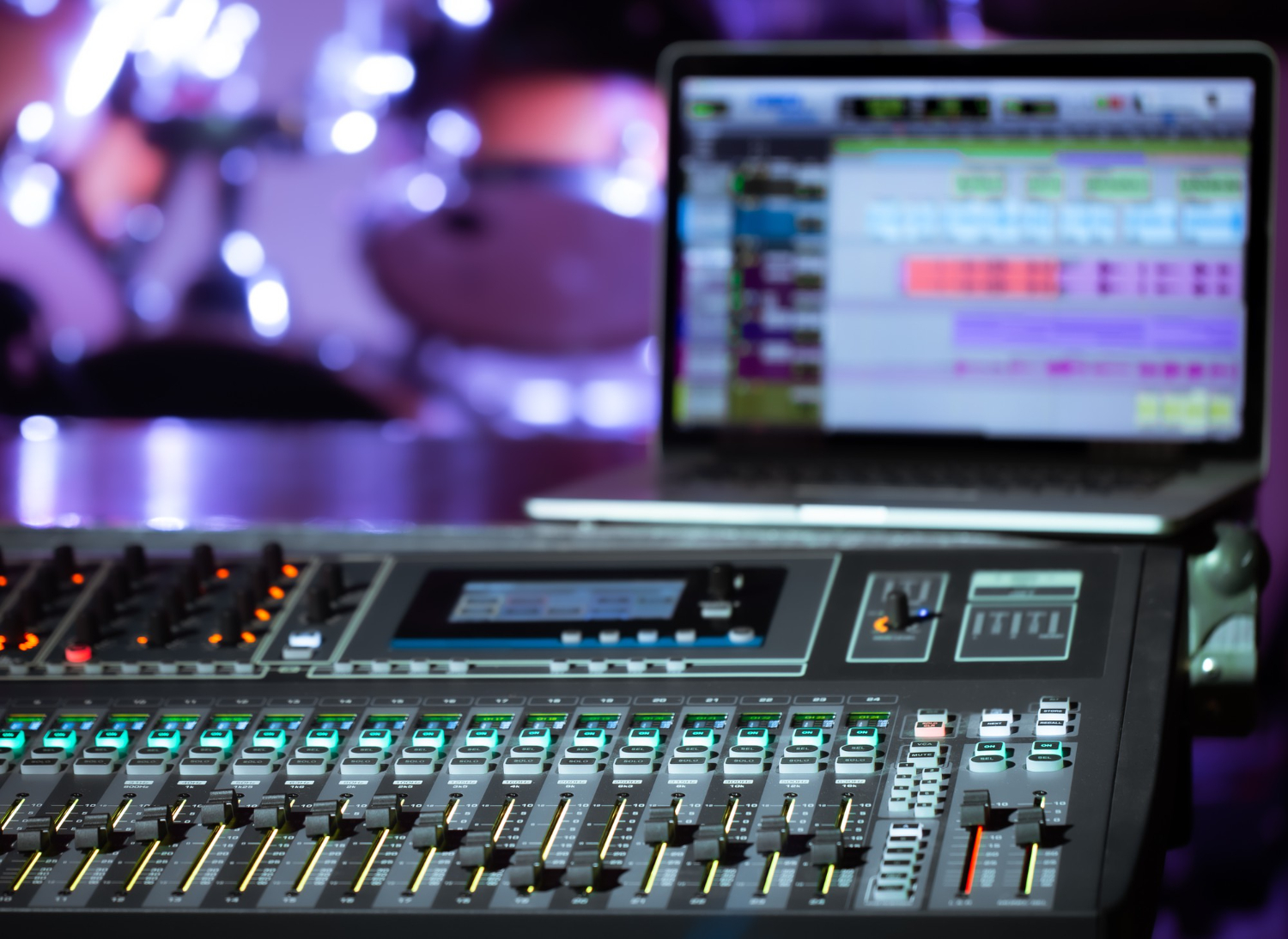
The console, signal processing, and equalization handled by an experienced technician make all the difference. A skilled sound engineer adapts the mix live to the room, the audience, and the event flow.
Redundancy
For premium events, failure is not an option. We provide secure power supplies, redundant connections, and backup equipment ready to take over.
Common mistakes to avoid
Here is what we see most often in the field:
- sizing based solely on capacity, without considering acoustics,
- neglecting delay speakers in deep rooms,
- underestimating setup and calibration : a poorly tuned system ruins excellent equipment,
- ignoring consistency with video and stage design : speakers blocking a screen, visible cabling,
- not scheduling a sound check with the actual content before doors open.
A concrete example
For an 800-person convention in a long conference hall, we deployed two main speaker arrays at the front, supplemented by two delay zones for the back. The result: clear speech in every row, a consistent volume from the first to the last row, and powerful closing music without listener fatigue. The client noted that "no one had to strain to hear," which is the best compliment a sound system can receive.
Event sound vocabulary at a glance
A few benchmarks to communicate effectively with your event audiovisual provider.
- Decibel and sound pressure level : the decibel (dB) measures the pressure level of a sound. A sound level meter allows you to monitor it in real time.
- Acoustic power and sound intensity : acoustic power describes what a sound source produces. Sound intensity then decreases with distance.
- Attenuation : sound waves lose approximately 6 dB every time the distance from the speaker is doubled.
- Absorption and absorption coefficient : these indicate a material's ability to absorb sound rather than reflect it.
- Amplifier, speakers, and mixing : the amplifier powers the speakers. The mix balances voice, music, and video.
- Microphone and receiver : the microphone captures the voice, and the RF receiver transmits it to the control room.
- Watt : a unit of electrical power, not to be confused with the sound level perceived by the audience's hearing.
- High frequencies and vibrations : high frequencies carry speech intelligibility. Bass vibrations are felt physically.
- Noise pollution and limitation : an amplified event must limit noise levels to protect the public and the surrounding area.
Decibels, logarithmic scale, and weighting
The decibel is based on a logarithmic scale. Two identical sound sources only add 3 dB. It takes about 10 dB more for the volume to sound twice as loud. The weighting dB(A) takes into account the sensitivity of human hearing, while dB(C) weighting is used for bass and peaks.
- Threshold of hearing and threshold of pain : the former is around 0 dB, the latter between 120 and 130 dB, with a risk of hearing damage.
- Sound intensity level and sound power level : the former measures what the listener perceives at a specific point, the latter what the source emits.
- Sound environment and ambient noise : air conditioning, audience, traffic. This audible noise sets the minimum level required for speech to remain clear.
- Noise exposure : duration matters just as much as volume. Our control room monitors levels continuously to protect the hearing of both the audience and the crew.
FAQ: Event sound reinforcement
How many speakers are needed for 200 people?
There is no universal number. For a 200-person conference, two well-placed front-of-house speakers are often sufficient. If music, bass, or a complex room layout is involved, the setup changes. A site survey helps determine the right approach.
What is the difference between conference sound and concert sound?
Conferences prioritize speech intelligibility at a moderate volume. Concerts aim for impact, dynamics, and bass. A corporate convention often combines both.
Why does my event have an echo?
Echo is usually caused by a reverberant room or poorly aimed speakers. Unsynchronized delay speakers can also be the cause. Precise calibration usually solves the problem.
Is a technical site survey necessary before the event?
Yes, it is highly recommended. It allows us to measure the room, identify rigging and power constraints, and avoid any surprises.
Can you provide sound for an outdoor venue?
Yes, but wind, distance, and open-air propagation change the requirements. You need more power, noise management for the neighborhood, and weather protection.
When should I contact an event audiovisual provider?
As early as possible, ideally as soon as the venue and capacity are known. We can then advise on the choice of site and coordinate the sound with video, lighting, and set design.
Conclusion: Great sound means a successful event
Sizing a sound system means balancing capacity, venue, content, and project constraints. It is precision work, carried out with method and field experience.
At VLS, we design sound systems tailored to your event, in harmony with video, lighting, and technical production. We work on your conventions, seminars, trade shows, and festivals throughout France.
Planning an event? Let’s talk about your project. Contact VLS for a site survey and a personalized quote: our teams will offer the sound solution best suited to your venue and your audience.
