
Why sound can make or break a corporate event
People might forgive a screen that’s a bit too low. They rarely forgive an inaudible speech.
At a corporate event, the spoken word is the heart of the program. Annual results, strategic vision, product launches: everything relies on the voice. If the intelligibility is poor, the message is lost, and the investment along with it.
Event sound systems address three key challenges:
- Ensuring clarity: every participant must hear every word, no matter where they are sitting.
- Setting the mood: background music, video audio, transitions, and festive moments, all with high-quality sound.
- Protecting the company's image: polished sound signals a well-managed event.
It is also a matter of comfort. A well-soundproofed room is less fatiguing. Attendees stay attentive longer, which is crucial for a two-day convention.
The components of a professional event sound system
A sound system consists of four main categories of equipment. Each has its role, and it is their synergy that determines the quality of the result.
A complete sound system is essentially a chain: sound sources, mixing console, amplifiers, and speakers. The final sound quality depends on every link. Well-balanced amplification, with amplifiers matched to the speakers, prevents distortion and protects the equipment.
Sound reinforcement: speakers and line arrays
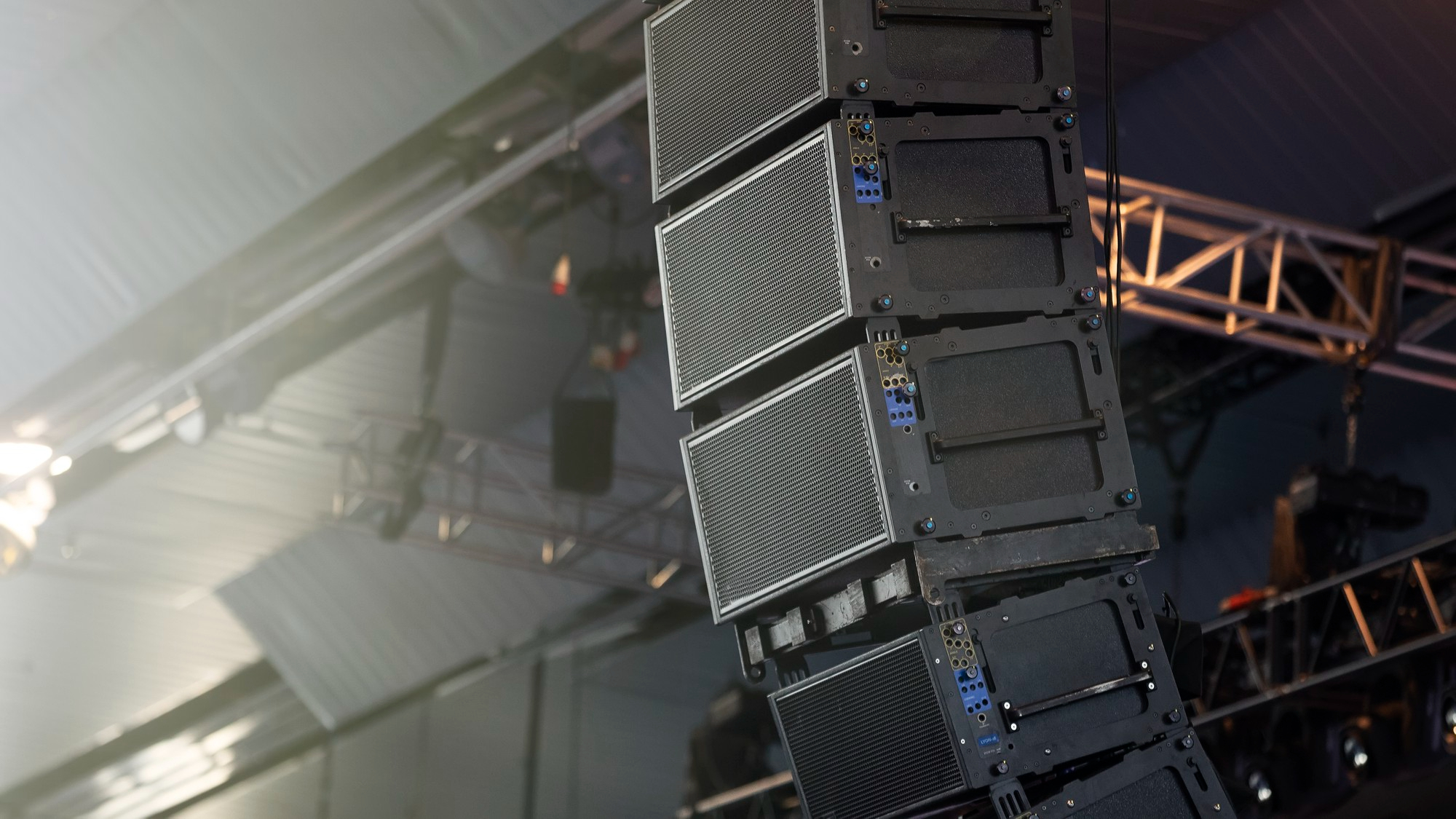
Sound reinforcement is what the audience hears. For medium to large venues, professionals use systems line array (L-Acoustics, d&b audiotechnik). These speakers, whether suspended or stacked in columns, distribute sound evenly from the first row to the last.
For a small seminar, compact speakers on stands are sufficient. For a room of 3,000 people, you need multiple sound zones, calibrated delays, and fine-tuning. Proper sizing depends on the venue, not just the number of guests.
Speakers work as a team. A subwoofer handles deep bass, while the main speakers reproduce mids and highs. Each speaker receives its power from a dedicated amplifier, sized in watts. We often talk about RMS power: this is the continuous value the system can handle without distortion.
The console and signal processing
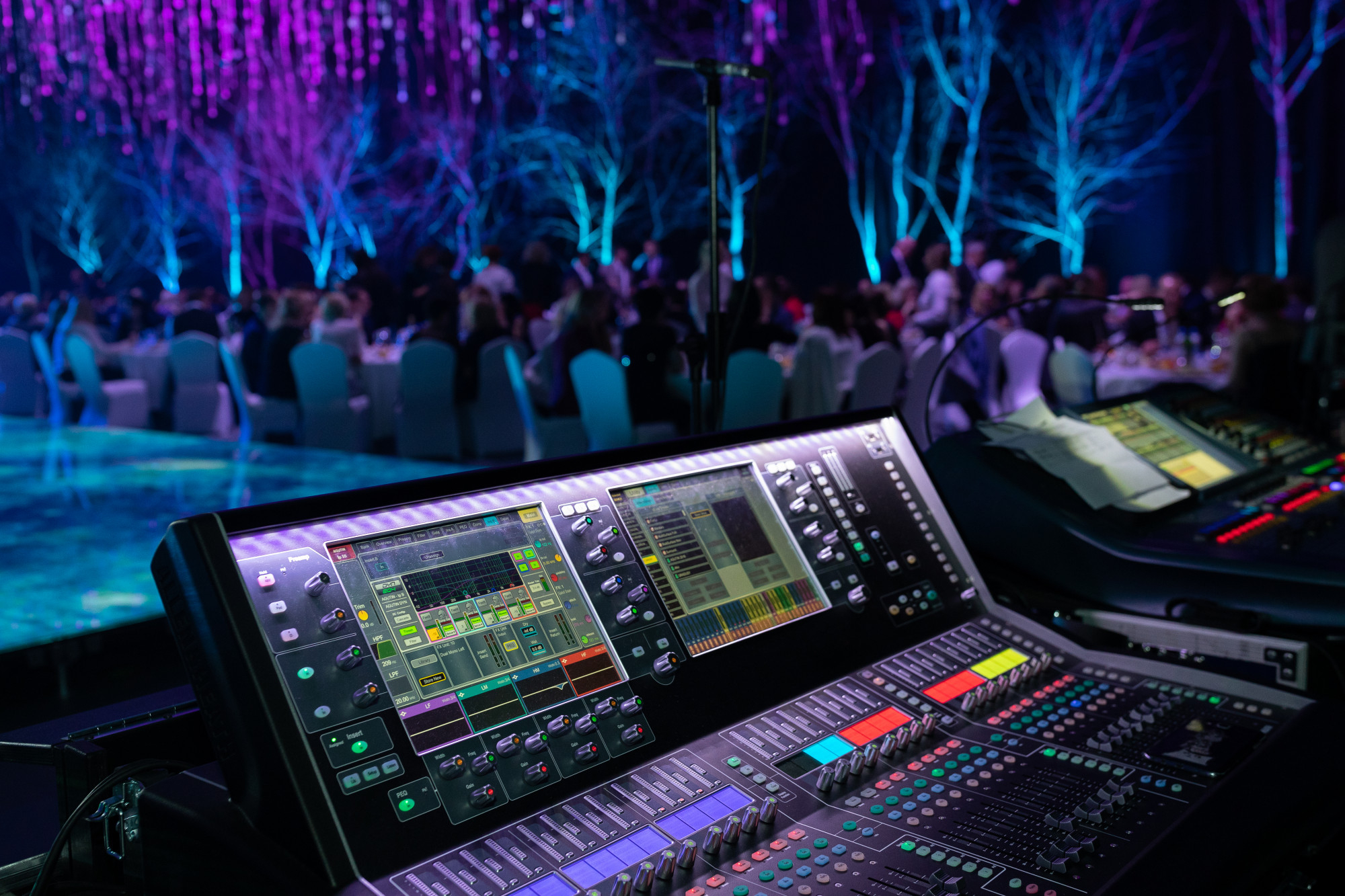
The mixing console is the brain of the setup. The sound engineer uses it to adjust levels, equalization, and effects. It also manages inputs: microphones, computers, video players, and remote speakers.
Signal processing corrects the room's acoustics. It is what prevents feedback and areas where the sound becomes muddy.
Mixing consoles can be analog or digital. Digital consoles now dominate the events industry: they store scenes and include comprehensive DSP. Analog retains its fans for its warmth and simplicity. In both cases, a good preamp is essential for capturing a voice faithfully. The final mix, whether in stereo or multi-zone, must remain consistent from one area to another.
Microphones: handheld, headset, lavalier
The choice of microphone changes the experience for the speakers.
- Handheld microphone: ideal for hosts and Q&A sessions with the audience.
- Headset microphone: discreet, it leaves hands free. Perfect for keynotes and dynamic presentations.
- Lavalier microphone: convenient, but more sensitive to clothing friction.
- Tabletop or lectern microphones: suitable for round tables and conferences.
They all operate via RF (wireless). Frequency management is a profession in its own right, especially in crowded venues like convention centers or trade shows.
Each wireless microphone communicates with a dedicated receiver located in the control booth. A well-positioned antenna ensures a stable signal, even in a crowded room.
Stage monitors
Monitors allow speakers to hear themselves. Without them, a speaker loses their bearings and a musician plays blindly. For a convention with a concert or live entertainment, they are essential.
This monitoring is handled via floor monitors or in-ear monitors. It is essential for live performance, where artists need to hear themselves to stay in tune.
Adapting sound reinforcement to the type of event
Every format has its own sonic logic. Replicating the same setup everywhere is a classic mistake.
Seminars and plenary meetings
The main priority is speech clarity. We favor reliable microphones, uniform sound distribution, and a compact control setup. The sound should remain discreet: it serves the content, it does not compete with it.
Corporate conventions
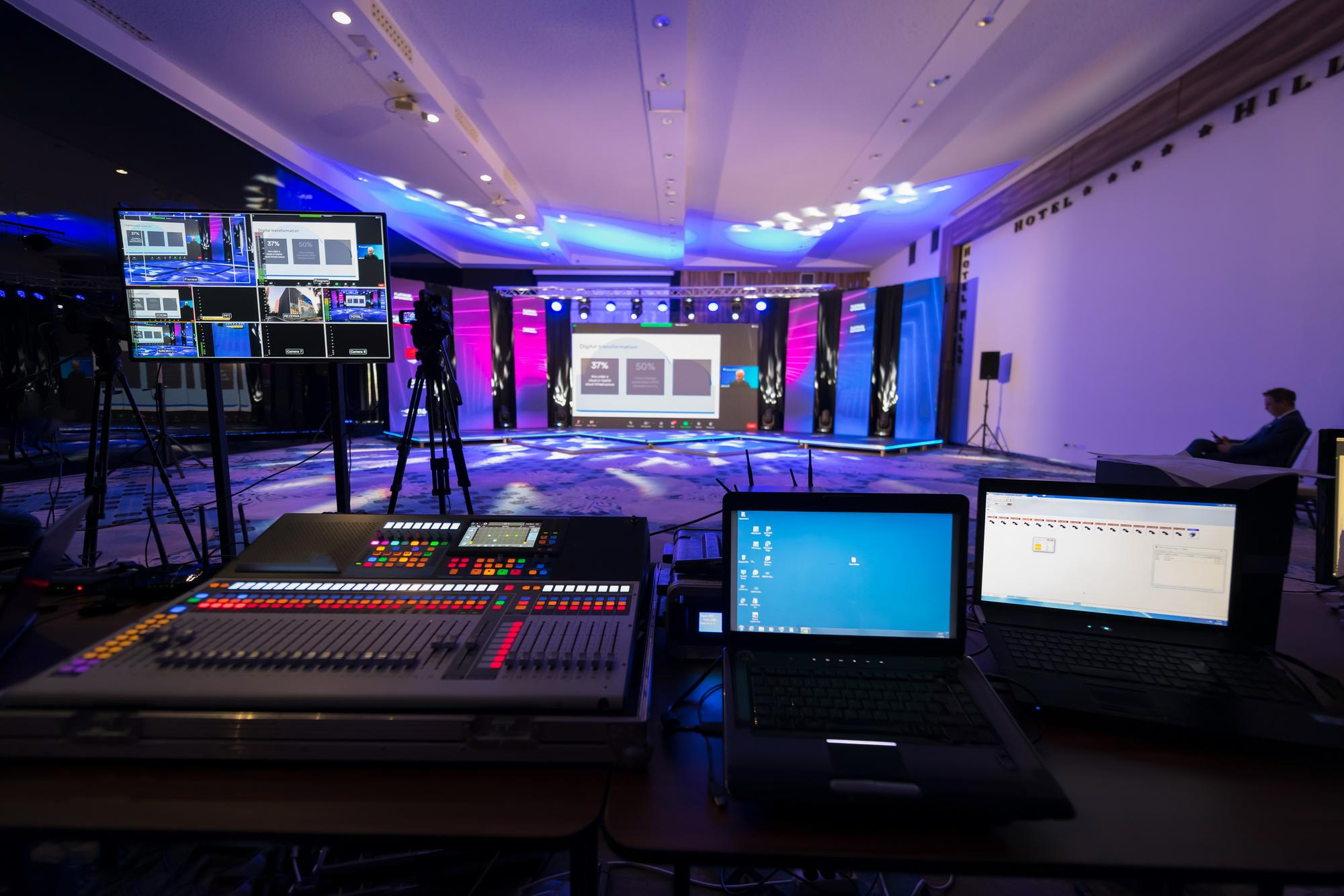
A corporate convention combines speech, video, music, and sometimes live performance. The setup must transition between sequences seamlessly: a speech, an opening film, a musical build-up, and a return to a calmer atmosphere. The sound engineer works in close coordination with the technical control roomlighting and video teams.
Gala dinners and festive events
Here, musical dynamics take center stage. You need power, but also control: the DJ or band should never prevent two colleagues from talking at their table. Adjusting volume levels is about finding a balance, not turning it up to the max.
Musical sources vary: CD players, computers, MP3 files, or Bluetooth connections. A professional prefers reliable, wired sources. Bluetooth should be reserved for secondary uses: it compresses the signal and can cut out at the worst possible moment.
Product launches
Sound reinforcement supports the staging. Sound contributes to the suspense, the reveal, and the emotion. It is often synchronized with lighting and LED walls, down to the exact timecode.
Acoustic pitfalls to anticipate
The venue dictates many factors. The same system will sound different in a private mansion, a theater, or an exhibition hall.
Here are the most common challenges:
- Reverberation: large spaces, glass, and stone reflect sound and muddy the speech.
- Long, narrow rooms: the back of the room may receive sound that is too quiet or delayed.
- Modular rooms: opening or closing a partition changes the entire acoustics.
- Heritage sites: you cannot always mount equipment. This requires non-anchored installation solutions.
- Neighborhood constraints: outdoors or in city centers, noise level limits apply.
A technical site survey helps identify these issues well before the big day. It is a step that a serious provider never neglects. It prevents hours of last-minute adjustments and unpleasant surprises on the morning of the event.
Sound reinforcement and hybrid events: audio for two audiences
Hybrid events bring together participants in the room and others connected remotely. The sound must therefore satisfy two audiences at the same time.
What sounds good in a room does not necessarily sound good in headphones. A mix dedicated to event streaming is often necessary. It must make voices clear, limit room noise, and integrate questions from remote participants.
A few points to consider:
- a separate mix for online broadcasting;
- ambient microphones to capture the atmosphere without interfering with speech;
- echo management when a remote speaker talks in the room;
- synchronization between image and sound in the live recording.
This is one of the areas where experience matters most. Poorly balanced sound will cause the online audience to tune out within minutes.
To archive the event, a multitrack recorder captures each microphone separately. The result is then reworked in a recording studio for a polished replay. This is on a different scale than a home studio: microphones, acoustics, and experience are incomparable. Professional studios provide that level of finish.
The steps to a successful sound reinforcement project
A successful setup is built in advance. Here is the method followed by a professional event audiovisual provider.
- The brief: number of participants, program, speakers, desired atmosphere, specific constraints.
- The technical site survey: venue measurements, acoustic study, access, power supply, rigging points.
- The design: system selection, sound coverage simulation, layout plan.
- Setup and configuration: installation, system calibration, microphone and frequency testing.
- Sound checks and rehearsals: speaker walkthroughs, level adjustments, sequence validation.
- Operation: a sound engineer and a technician remain in the control booth throughout the event.
- Dismantling: fast, clean, and organized according to venue requirements.
For large-scale projects, this process involves several technicians and days of preparation. The goal remains the same: ensuring the audience never has to think about the technical side.
What budget should you plan for corporate event sound reinforcement?
The budget depends on the size of the venue, the duration, the number of microphones, and the complexity of the program. As a general guide, here are some rough estimates:
- Seminar for 50 to 150 people: a compact system with wireless microphones and a technician, for a few thousand euros.
- Convention for 300 to 800 people: a line array system, a full sound control room, and multiple microphones, with a significantly higher budget.
- Large-scale or hybrid event: multi-zone sound distribution, dedicated streaming mix, and an expanded team.
These ranges vary depending on the venue and your specific requirements. A reliable quote can only be provided after discussing your project.
A piece of advice: don't sacrifice sound quality to pay for a larger screen. A spectacular LED wall with inaudible speech is always a disappointment. It is better to have a balanced setup.
How to choose your event sound provider
A few criteria help distinguish a true partner from a simple equipment rental company:
- References: demanding clients and events comparable to yours.
- Equipment quality: recognized brands, recent gear, and well-maintained inventory.
- The team: experienced sound engineers, present on-site from start to finish.
- Comprehensive vision: ability to coordinate sound, lighting, video, and technical production.
- Expertise: A good service provider will challenge your brief instead of just saying yes to everything.
- Compliance: adherence to safety standards, up-to-date insurance.
A full-service event audiovisual provider offers a clear advantage. A single team manages sound, image, and lighting. There are fewer points of contact, and the overall consistency is better.
FAQ: Corporate event sound systems
How many microphones should be planned for a convention?
That depends on the program. Count on at least one microphone per main speaker, plus backup microphones. For a panel discussion, plan for one microphone per participant. One or two handheld microphones for audience questions will complete the setup.
What is the difference between sound reinforcement and technical management?
Sound reinforcement concerns the audio: distribution, microphones, and mixing. Technical management coordinates all on-site disciplines: sound, lighting, video, and stage. For a complex event, the technical director orchestrates everyone.
Can you provide sound for an event in a heritage building?
Yes, with adapted solutions. Non-invasive supports, discreet speakers, and neat cabling allow us to respect the venue. A preliminary site visit is essential.
How can you avoid feedback (whistling)?
We use several levers: placement of microphones and speakers, equalization, gain management, and the choice of appropriate microphones. An experienced sound engineer anticipates these risks during soundchecks.
Is a specific mix required for a hybrid event?
Yes, it is highly recommended. The online audience does not hear the sound the same way as the in-person audience. A dedicated mix ensures clear voices and a pleasant experience for both audiences.
How far in advance should you contact a service provider?
Ideally between 6 and 12 weeks before the event, and longer for a convention or a hybrid project. This allows time for site visits, design, and testing.
Conclusion: entrust your sound to experts
Good event sound goes unnoticed. It leaves the spotlight entirely on your messages, your speakers, and your guests. That is what makes the difference between a decent event and a memorable one.
At VLS, we design custom sound setups for conventions, seminars, galas, and hybrid events. Our team supports you from the initial site visit to teardown, with the same high standards we apply to our largest projects.
Planning a corporate event? Let's talk about your project. Contact the VLS team for personalized advice and a quote tailored to your event.
