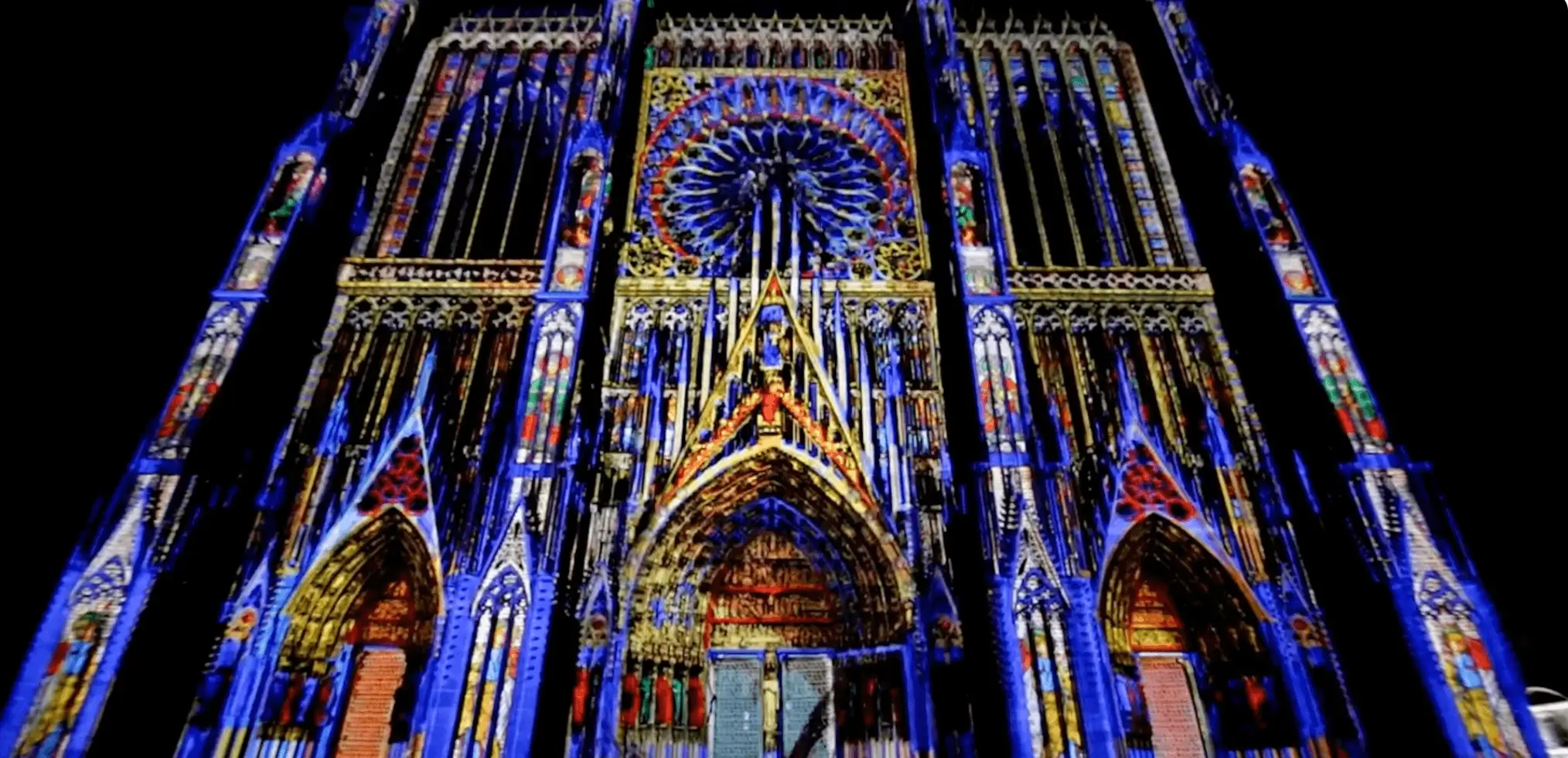

The cost of 3D mapping depends on a set of technical and creative factors: the size and geometric complexity of the surface, the power and number of projectors required, the duration of the show, the production of bespoke visual content, and the size of the technical crew mobilised on site. There is no single fixed price for video mapping.
Before requesting a projection mapping quote, understanding the budget lines that make up a project helps you prepare a meaningful brief, anticipate trade-offs and engage in a productive conversation with a specialist technical provider like VLS. This guide breaks down every cost driver behind 3D mapping cost.
What does the price of 3D mapping depend on?
3D mapping cost is the result of an equation with several unknowns. Every project is unique, because every surface, every venue, every creative ambition and every logistical constraint generates specific technical requirements. Technical providers build a custom budget by carefully analysing each of these variables before proposing a quote.
The surface and its geometric complexity
A flat facade 20 metres wide does not require the same technical preparation as a complex sculpture with multiple angles or a listed historic building with irregular ornamental details. The larger and more complex the surface, the greater the number of projectors needed, the more meticulous the calibration process (warping and blending), and the more precisely the content must be designed to match the geometry. 3D mapping price rises directly with surface complexity.
Projector power and quantity
Brightness is measured in lumens. To cover a surface under night conditions, projectors ranging from 10,000 to 30,000 lumens often suffice for small or medium-sized objects. For a building facade of 50 metres or more, machines delivering 40,000 to 80,000 lumens or several stacked laser projectors are typically required. The rental or acquisition of such equipment represents a significant share of overall video mapping cost.
Project duration and number of shows
A single-night show does not carry the same equipment rental costs, travel expenses or crew fees as an event repeated over several consecutive nights or a permanent installation. The rental period and the technical crew's on-site presence during shows directly influence the total 3D mapping budget. Multi-night runs significantly improve cost efficiency per event.
Content creation: bespoke or catalogue?
Visual content is often the most variable budget line. A client who wants fully original content, with specific 3D animation, integrated brand identity and complex narrative sequences, will invest considerably more than one who accepts a more generic visual treatment or who already holds usable graphic assets. Bespoke creation demands substantial time for concept development, 3D modelling and rendering, all of which drive up the video mapping price.
Venue constraints and logistics
A listed monument requiring special permits, a congested space, a site needing road-closure authorisation, a high-level installation requiring a cherry picker, or an outdoor projection under uncertain weather conditions: each logistical constraint translates into cost. Pre-event surveys, feasibility studies, administrative permits and site-access conditions all enter the overall projection mapping cost calculation.
Sound and light synchronisation
A 3D mapping show accompanied by an original sound design, a multi-channel diffusion system and synchronisation with stage lighting represents a more complex and more expensive project than a simple silent projection. Integrating these additional layers can significantly increase the budget while multiplying the visual and sensory impact of the show.
Budget lines in a 3D mapping project
A 3D mapping budget breaks down into distinct lines, each contributing to the total 3D mapping cost in a way that varies according to the specific characteristics of the project. The table below presents the main budget items to anticipate when requesting a mapping quote.
| Budget line | What it covers | Impact on cost |
|---|---|---|
| Survey and feasibility | 3D surface scan, technical feasibility, projection angle and distance calculations | Moderate but essential; varies with site accessibility and complexity |
| Content creation | Animation, motion design, 3D modelling, rendering, brand identity integration | High to very high depending on customisation level and show duration |
| Equipment rental | Laser video projectors (power matched to surface), media servers, cabling, rigging | Variable; grows significantly with surface size and number of projectors required |
| Technical crew | Project manager, projection engineers, rigging and de-rigging technicians, operators | Significant; depends on crew size and total mobilisation duration |
| Transport and logistics | Equipment delivery, cherry pickers, generators, long-distance cabling infrastructure | Moderate to high; increases with distance from base and site-access constraints |
| Sound and light sync | Audio diffusion system, mixing console, temporal synchronisation with stage lighting | Optional but impactful; can represent 10 to 25% of total budget depending on scope |
| Permits and safety | Road closure applications, prefectural orders, security personnel, perimeter marking | Variable depending on local regulatory constraints and event scale |
| Rehearsals and testing | Calibration sessions, warping and blending adjustments, rehearsals with creative teams | Often underestimated; can represent one to two additional technical days |
Indicative ranges by project type
The ranges presented here are strictly indicative and given as a general orientation based on project types observed in the market. They do not constitute a pricing commitment from VLS, whose quotes are always built on a bespoke basis after analysing the client's actual needs.
Mapping on an object or event stand (small scale)
3D mapping on an object of a few metres, such as a product, a sculpture, a scenic cube or a vehicle, for a trade show, product launch or corporate event represents the entry level of the sector. The limited surface allows for lower-power projectors, and the content, even if bespoke, typically runs for a few minutes on loop. As a general indication and depending on the project, this type of service sits within ranges spanning from a few thousand to several tens of thousands of euros, depending on the level of content customisation and the duration of the equipment rental.
Mapping on a building facade (medium scale)
A facade of 20 to 50 metres wide, a chateau, a town hall or a concert venue requires intermediate to high-power projectors, content animated specifically for the building's geometry, and a larger technical crew. The projection mapping cost for this type of project is considerably more significant. As a general indication, this segment typically involves budgets well above the entry-level ranges, with important variables depending on the number of nights, content complexity and venue constraints.
Monumental mapping on a large facade or infrastructure (large scale)
Monumental projects on cathedrals, facades of several hundred square metres, bridges or industrial infrastructure represent the high end of video mapping cost. These projects mobilise large teams over several days or weeks, very high-power laser projectors, long-duration content creation and complex logistics. The 3D mapping budget at this scale is built entirely on a bespoke basis after an in-depth technical study. To learn more about the technical possibilities at this scale, see our article on monumental 3D mapping and building projection.
What these ranges do not capture
Indicative ranges do not always account for cost overruns linked to particular situations: a listed site requiring special authorisation, a venue in a restricted-access zone, very short deadlines requiring a reinforced crew, or integration within a broader event setup including video capture, streaming or an immersive scenography. Only a detailed quote allows the true 3D mapping price of a project to be determined.
How to optimise your 3D mapping budget
Optimising a 3D mapping budget does not mean cutting quality, but identifying efficiency levers that deliver the best result for the investment. Here are the main optimisation strategies to consider.
Plan the project well in advance
Short timelines force technical providers to mobilise resources urgently, which generates cost overruns. A project conceived several months in advance allows calm planning of surveys, obtaining permits without additional fees and avoiding last-minute surcharges on equipment rental. Anticipation is one of the most effective cost-control tools available.
Clarify the intended use of the content
Content created for a single evening does not carry the same amortisation cost as content reused across multiple events or adapted into several languages for an international tour. Planning multiple uses of the content from the outset allows creation costs to be shared, reducing the 3D mapping budget per event. This is a particularly effective lever for brands running recurring activations.
Rationalise the projection surface
A slightly smaller or more accessible surface can reduce the required projector power and therefore the equipment rental cost. This decision should be made with the technical provider, as a poorly calibrated reduction can compromise visual impact. The right surface-to-budget ratio is a key element of any pre-project technical discussion.
Group consecutive shows
If the project involves several evenings of diffusion, grouping them on consecutive nights rather than dismantling and reinstalling the setup multiple times reduces handling, transport and technical crew costs. The 3D mapping price per evening decreases mechanically when fixed costs are spread across several shows. This is a simple but powerful optimisation lever.
Work with an integrated provider
A technical provider like VLS, which has its own equipment fleet and in-house content creation teams, avoids the multiplication of intermediaries and the accumulated margins of a subcontracting chain. Working with an integrated operator often delivers better overall value for money. Discover our approach in the large-image and projection section of our site.
Define creative expectations precisely
Back-and-forth during content creation is one of the main sources of budget overruns. The more precise the creative brief from the outset, including visual references, duration, brand identity and technical constraints, the fewer and less costly the iterations will be. A rigorous specification document is the most cost-effective upfront investment for any 3D mapping project.
Get a bespoke quote for your 3D mapping project
Obtaining a relevant 3D mapping quote requires sharing as much project information as possible with the technical provider: the venue and its dimensions, the event date and duration, the creative ambition, the broadcast context, whether outdoors at night or indoors, and if possible a reference budget envelope.
VLS supports its clients from the first reflections through to final delivery: survey, technical advice, content creation, deployment and operation. This integrated approach ensures coherence between artistic ambitions, technical constraints and budgetary realities. Explore our mapping and projection portfolio to see the range of projects we have delivered.
To start the conversation and receive an initial framing of the projection mapping cost for your project, contact our team. We will propose an initial technical analysis with no commitment, followed by a detailed quote tailored to your real needs.
To better understand what 3D mapping is and how it works before approaching the budget question, read our complete 3D mapping guide.
Frequently asked questions about 3D mapping cost
Why is it impossible to get a fixed price for 3D mapping?
3D mapping cost results from a unique combination of project-specific factors: the surface to be projected onto, the equipment required, the duration, the content complexity and the logistical constraints of the venue. Two projects that appear similar from the outside may require very different technical resources. Only an analysis of actual needs makes it possible to establish an accurate and coherent budget.
Which budget line is the largest in a 3D mapping project?
The most significant line varies by project type. For object mapping, bespoke content creation is often the highest-cost item. For a monumental project, very high-power laser projector rental and technical logistics can dominate the budget. In all cases, content and equipment are the two main lines to anticipate when requesting a 3D mapping quote.
Is 3D mapping more expensive for a historic building?
Yes, as a rule. A historic building typically presents more complex geometry, with ornaments, reliefs and irregularities requiring more meticulous calibration work. Added to this are regulatory constraints, specific permits and sometimes restrictions on access or installation methods. These factors increase projection mapping cost compared to a flat, easily accessible surface.
Does show duration significantly affect the price?
Duration affects the 3D mapping budget at two levels. On one hand, it determines the volume of content to be created, which is one of the most costly items. On the other, it influences the equipment rental period and the technical crew's on-site presence. A 10-minute looping show requires less production effort than a 20-minute narrative show with several distinct sequences.
Can video mapping cost be reduced by using existing content?
Yes, in certain cases. If a client already holds graphic resources, animations, videos or brand assets that can be adapted for the projection surface, the work of creating from scratch is reduced, which may lower that budget line. However, adapting assets to the specific geometry of the surface remains necessary in all cases and represents technical work the provider must still carry out.
Does the number of show nights significantly change the cost per evening?
Yes. Fixed costs such as installation, survey and content creation are spread across all shows. The more evenings scheduled, the more optimised the 3D mapping price per evening. An installation planned for five consecutive nights will therefore be less expensive per show than a single one-night event, at equivalent technical scope.
Should a contingency budget be set aside for unforeseen events?
Yes, this is best practice. Any outdoor event or project on a site with specific constraints may face unforeseen factors: weather conditions, permit delays, technical discoveries on site. Setting aside a contingency envelope of 10 to 15 percent of the total 3D mapping budget is common practice and recommended by sector professionals.
Does VLS provide quotes for projects outside Ile-de-France?
Yes. Although VLS is based in Buc, Yvelines, the company works across France and internationally on large-image and 3D mapping projects. Travel and equipment transport costs are integrated into the quote according to the project location. The video mapping price is adjusted to reflect the specific logistical constraints of each site.
Read also:
3D mapping: definition, how it works and applications
Monumental 3D mapping: projection on buildings and facades
VLS mapping and large-image portfolio
