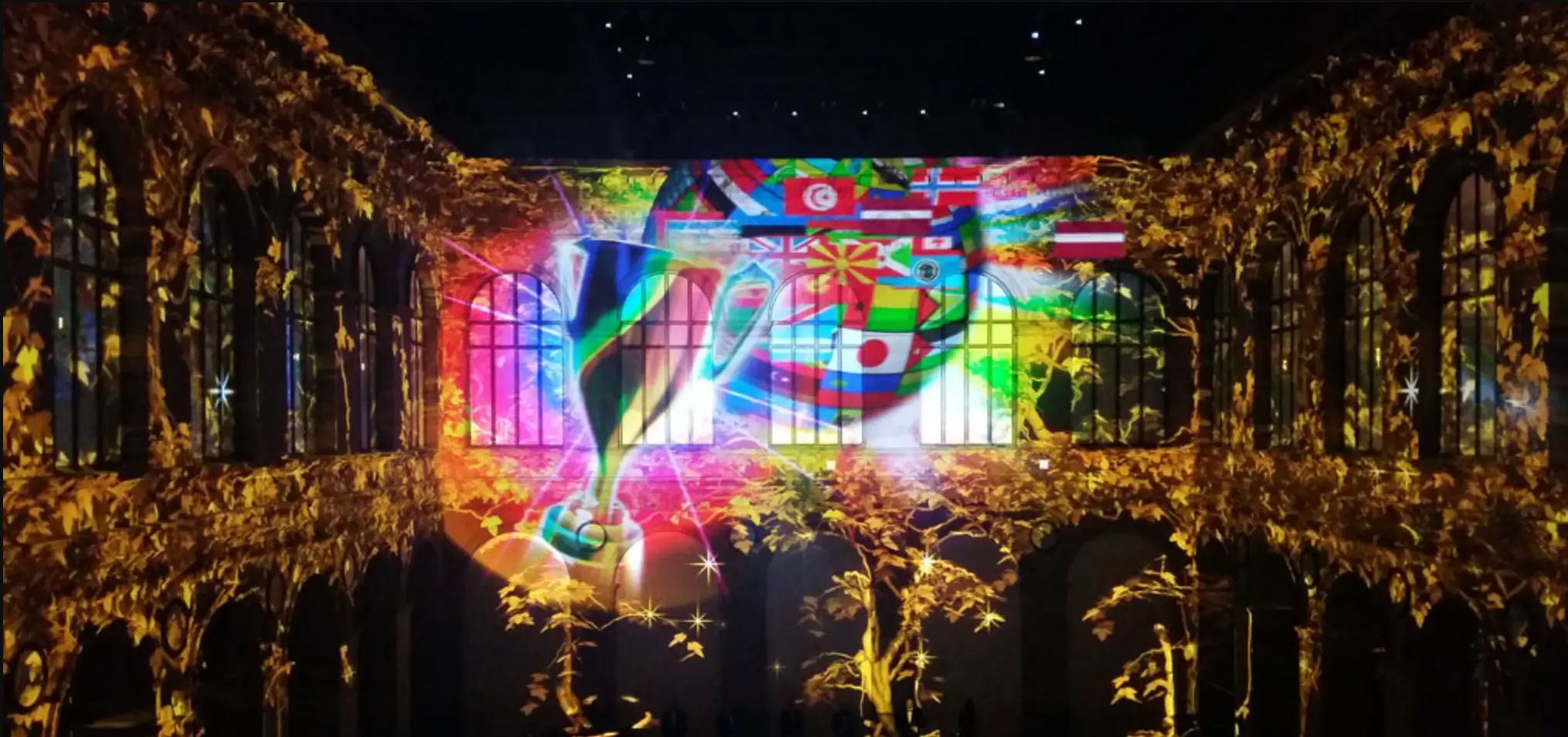

Video mapping is the umbrella term for any video projection calibrated to the shape of a real surface. 3D mapping is its most advanced form: it exploits the relief of a surface to create optical illusions, depth effects, and trompe-l'oeil impossible on a flat screen. Choosing between the two starts with understanding what each technique can deliver for your specific project.
The two terms often circulate as synonyms, but they cover very different technical, budgetary, and creative realities. This comparison helps you see clearly, ask the right questions when briefing a supplier, and avoid misunderstandings from the start.
Definitions: video mapping and 3D mapping
Video mapping refers to all projection techniques that adapt a video image to the shape of a real surface, whether flat, curved, irregular, or monumental. The goal is straightforward: make the supporting surface disappear so that the projected light becomes the only element perceived by the audience.
3D mapping is a sub-category of video mapping. It is defined by the active use of the surface's relief: a building facade with its protrusions, windows, and ornamental details, a sculpture, or an object with its own volumes. The 3D modelling of the surface is integrated into the creative process, making it possible to produce depth effects, explosion sequences, collapse animations, and architectural storytelling that precisely follow every geometric detail of the real surface.
To go deeper into 3D mapping fundamentals, read our complete 3D mapping guide. For a broader look at monumental video projection, see our dedicated page on monumental 3D mapping on buildings and facades.
The real differences between video mapping and 3D mapping
The essential distinction between the two techniques lies in how the geometry of the surface is taken into account during content creation and projection calibration.
| Criterion | Video mapping (generic) | 3D mapping |
|---|---|---|
| Target surface | Flat, curved, or slightly irregular (wall, podium, stage, scrim) | Marked relief: architectural facade, sculpture, complex volumetric object |
| Modelling | 2D mask or light geometric correction | Precise 3D survey and modelling of the real surface |
| Trompe-l'oeil / depth effect | Limited or absent | Central: optical illusions, facade explosion, volumetric animation |
| Technical complexity | Moderate to high depending on surface | High to very high (3D survey, rendering, multi-projector alignment) |
| Software and tools | Warping and blending software (Resolume, MadMapper, etc.) | 3D tools (Blender, Cinema 4D) upstream, then precise surface alignment |
| Number of projectors | Often one to a few projectors | Multiple projectors common, sometimes dozens on large-format projects |
| Preparation time | A few days to a few weeks | Several weeks to several months for monumental projects |
| Relative cost | Variable by content and duration, generally more accessible | Higher, driven by 3D survey, rendering, and multi-projector installation |
| Typical uses | Event staging, retail, trade show, indoor projection | Building illuminations, monumental shows, museums, art installations |
In everyday usage, "video mapping", "projection mapping", and "3D mapping" often overlap in casual conversation. The key distinction: 3D mapping always refers to the volumetric, architecture-driven variant of the discipline, where the surface relief is the creative material rather than just a backdrop.
When to choose 3D mapping
3D mapping is the right answer when the surface itself is the creative material, not simply a display medium.
You are projecting onto an architectural facade with genuine relief. Windows, columns, cornices, and carved ornamental details become animation elements. Without 3D modelling of those details, the projection will not align with the geometry and the result will be flat and unconvincing.
Visual impact at a distance is critical. 3D mapping, through its optical illusion effects and volumetric animations, captures attention from great distances and in contexts with heavy visual competition: public spaces, festivals, national celebrations. It is the format that generates the most social media sharing and media coverage.
You need strong architectural storytelling. Making a facade appear to collapse, transform, catch fire, or open onto another world: these effects rely entirely on the precision of the 3D survey and the quality of the creative content. A straightforward video mapping on a flat surface cannot reproduce them.
The project is monumental or institutional in scale. Illuminations of town halls, cathedrals, museums, opera houses: 3D mapping has become the reference format for official celebrations, brand anniversaries, and infrastructure inaugurations. For large-scale architectural projects, see our page on monumental 3D mapping on buildings.
You want to enhance a product or object in 3D. Mapping onto a product (a car, a perfume bottle, a sculpture) applies the same principles as architectural mapping at a different scale. Modelling the real object enables animations that follow its curves and surfaces precisely.
VLS has been supporting clients on these complex projects for over forty years, handling 3D survey, content creation, equipment selection, and installation. To discuss your project, contact our team.
When simpler video mapping is sufficient
Video mapping without a complex 3D dimension is often the most appropriate and efficient solution for a large number of event and experiential projects.
Your surface is flat or regular. A white wall, a cyclorama, a scrim, a facade with no particular relief: projection calibrated to these surfaces produces a highly effective immersive experience without requiring 3D modelling. The quality of the video content and the power of the projectors make all the difference.
You are working with tight deadlines. A video mapping on a flat surface can be prepared in a few days to a few weeks. The 3D survey and modelling phase required for architectural mapping adds significant weight to the timeline. If your project has strong time constraints, standard video mapping is often the more realistic choice.
Budget is a primary concern. The cost of a video mapping is mainly driven by the length of the creative content, the power of the projectors, and the installation time. 3D mapping adds the survey, the modelling work, and typically a larger projector fleet. If trompe-l'oeil effects are not a central objective, standard video mapping delivers an excellent ratio of impact to investment.
The experience needs to loop continuously or be interactive. For looping installations in retail spaces, museums, or trade show booths, video mapping on flat or gently curved surfaces integrates more easily into the scenography and the constraints of long-duration operation.
The surface is temporary or mobile. Festival stages, ephemeral podiums, theatre sets: video mapping adapts to structures that cannot be subjected to a permanent 3D survey. Recalibration flexibility is a major advantage in these contexts.
To understand the equipment behind these projections, discover our large-format video projection expertise.
What video mapping and 3D mapping have in common
Despite their differences, both approaches share the same fundamental requirements in terms of equipment, expertise, and installation conditions.
High-brightness projectors. Whether for an indoor video mapping or a monumental 3D mapping, the light output of the projectors is decisive. Ambient light (daylight, stage lighting) is the shared enemy of both techniques: every video projection project requires a rigorous analysis of on-site lighting conditions.
Precise image alignment. In both cases, the projection must be aligned to the pixel on the real surface. This process, called warping and blending, demands specific technical skills and on-site calibration time that must be planned into the project schedule from the start.
The need for darkness or low ambient light. No video projection can compete with strong ambient light. Even 3D mapping on a cathedral facade only works after dark. This constraint is identical for both techniques and must be factored into the project design from the outset.
High-quality creative content. Technology does not compensate for weak content. Whether 2D or incorporating 3D modelling, the projected video content must have been designed specifically for the target surface, with its proportions, constraints, and context in mind. Content creation expertise is just as important as the equipment.
On-site installation and live operation. Both techniques require technical teams on-site for installation, calibration, and live operation. The complexity of the technical direction varies with the number of projectors and the nature of the content, but no project runs without qualified technical staff present.
Choosing the right approach with a technical partner
Choosing between video mapping and 3D mapping starts with a precise brief and an open conversation with an experienced technical partner.
The questions to ask at the first meeting are straightforward: what is the actual surface? Does it have relief worth exploiting creatively? What effect are you looking for: immersion, trompe-l'oeil, architectural storytelling? What are your timelines and available budget? What is the ambient light level during the show?
A serious partner will not systematically recommend 3D mapping because the term sounds more impressive. They will analyse your surface, your objectives, and your constraints to recommend the most appropriate technique, sometimes a combination of both. They should also be able to offer an on-site technical visit before any quote is validated.
VLS, a technical audiovisual specialist since 1983, holds unique expertise across the full spectrum: from event projection on flat surfaces to large architectural mappings on historic monuments. Our team supports you from concept to final calibration, including 3D survey and content creation. Discover our large-format projection expertise or get in touch with our team to discuss your project.
FAQ: video mapping vs 3D mapping
What is the difference between video mapping and 3D mapping?
Video mapping is the umbrella term for any video projection adapted to a real surface. 3D mapping is an advanced form of video mapping that actively exploits the surface's relief to create depth effects and optical illusions. The key difference lies in the 3D modelling of the surface and the volumetric effects that modelling makes possible. Every 3D mapping is a video mapping, but the reverse is not true. The choice depends primarily on whether your surface has relief worth using creatively.
Can 3D mapping be done on any surface?
No. 3D mapping delivers its full potential on surfaces with genuine relief: architectural facades, sculptures, and volumetric objects. On a flat surface, there is no geometry to exploit and the trompe-l'oeil effects that define 3D mapping simply cannot work. In that case, standard video mapping is the pertinent solution, usually more appropriate and less costly for the same surface area. The surface survey determines which approach is right.
Is 3D mapping always more impressive than simple video mapping?
Not necessarily. Visual impact depends above all on the quality of the creative content and the match between the chosen technique and the surface. A video mapping on a large flat surface with strong content and high brightness can produce an experience just as memorable as a 3D mapping on a complex facade. The technique should serve the message, not impose itself for its own sake. Choosing correctly is as important as investing in the most powerful technology.
How long does it take to prepare a 3D mapping project?
A 3D mapping project involves several phases: technical site visit and surface survey, 3D modelling, video content creation, rendering tests, installation, and final calibration. On a monumental project, this preparation can take several months. A video mapping on a simple surface can be prepared in a few weeks. Anticipating these timelines from the start is essential to avoid last-minute pressure on production quality.
Is "video mapping" the same as "projection mapping"?
Yes, in most professional contexts. The terms video mapping, projection mapping, and video projection mapping refer to the same discipline. Usage varies by country and supplier, but the underlying technique is identical. The term 3D mapping is more specific and always points to the volumetric, relief-driven variant of the practice. When in doubt, ask your technical partner to clarify what they mean by each term in the context of your specific project.
Does 3D mapping always require multiple projectors?
Not always, but it is common on architectural projects. A single object or sculpture can be mapped with one correctly positioned projector. However, a wide building facade or a historic monument typically requires multiple projectors whose images are assembled with precision through edge blending. The number of projectors is determined during the technical site visit and depends on the surface area to cover and the required brightness level for the ambient conditions.
Can 3D mapping be done indoors?
Absolutely. If the interior architecture of a venue features interesting volumes such as columns, vaulted ceilings, domes, or staircases, indoor 3D mapping produces striking effects in a controlled environment. The advantage of indoor settings is complete control over ambient light, which significantly improves rendering quality and the precision of trompe-l'oeil effects. Indoor 3D mapping is well suited to museums, heritage venues, and high-end event spaces.
How do I know whether my project needs 3D mapping or standard video mapping?
The central question is about the surface: does it have relief that can be exploited creatively? If yes, 3D mapping is the pertinent approach. If the surface is flat or if the goal is primarily to project strong content without volumetric effects, standard video mapping is the most effective and economical answer. A technical site visit with an experienced partner like VLS makes it possible to answer that question definitively, based on the reality of your surface and your project objectives.
Read also:
3D mapping: complete guide
Monumental 3D mapping on buildings and facades
Large-format video projection expertise at VLS
